
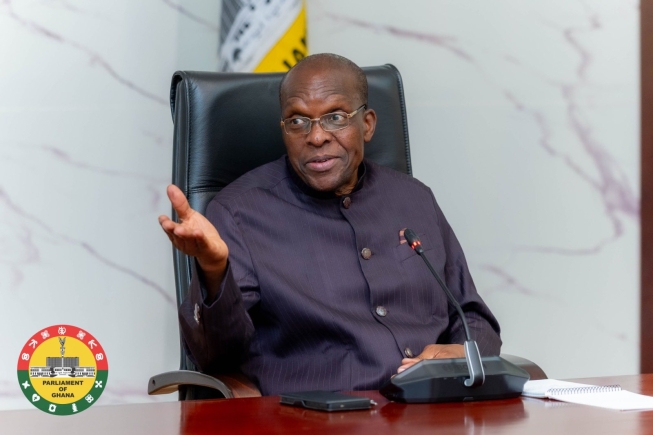
The Speaker of Parliament, Alban Sumana Kingsford Bagbin, has “pleaded” with the Executive to release a parcel of land around Parliament to pave the way for the construction of a "permanent seat" for Parliament.
He said there were a lot of infrastructure limitations Parliament faced today and having a permanent seat- a Parliament House- would enhance parliamentary business.
“We have been crying, and I hope you support us in that, at least we should be liberated from being tenants of the State House to having our own premises as an arm of government.
Background
Related article: Speaker Bagbin calls for new chamber for 276 MPs, raises concern over limited capacity
It would be recalled that in October 2025, Speaker Bagbin raised concerns about the limited capacity of the current parliamentary chamber.
He cautioned that the structural integrity of the facility could be compromised if the number of Members of Parliament (MPs) continues to increase.
He made the October call following the swearing-in of two new members — Bernard Bediako Baidoo for Akwatia and Professor Alidu Seidu for Tamale Central to bring the House to its full complement of 276 MPs.
“We are happy now to have the full complement of the House. We now have 276 MPs… Anytime the number increases, we have to create space for the member. So please, before this number increases, you must, as a country, as a Republic, start looking for a proper place,” Mr Bagbin stated on that occasion.
“If not, the integrity of this structure is being undermined — a word to the wise is enough,” Mr Bagbin cautioned.
The current parliamentary chamber last year [2025] underwent renovations, including a €2.26 million project to upgrade the facility.
However, Mr Bagbin emphasized that these renovations may not be sufficient to accommodate the growing number of legislators.
Corporate Strategic Plan from 2026-2030 of the Legislature
Release land for Parliament to have permanent seat and enhance legislation - Speaker pleads with the Executive
Graphic Online's Nana Konadu Agyeman reports that speaking at the outdooring of the Corporate Strategic Plan from 2026-2030 of the Legislature in Parliament on Thursday [Feb 12], Mr Bagbin said in spite of being a pillar of Ghana’s democracy, Parliament faced difficulties in accessing some structures on the precinct of Parliament to undertake certain activities.
“We cannot access some of the structures here, including the Banquet Hall, until we ourselves pay, and now it is falling into disuse, and we have to spend a lot of money to bring it back.
“There are a lot of infrastructure limitations, and it has not been easy; even when we are about to make a decision, you cannot make a decision when there is no consensus with the voting.
“So, this strategic plan has been developed in direct response to these realities,” he said.
The strategic plan, which sought the inputs of the citizens and civil societies across the country, articulates a clear, a forward-looking vision for a model people-centred inclusive and proactive Parliament that is firmly grounded in constitutionalism and pragmatism.
Championed by the Speaker, the plan is guided by evidence-based decision-making and strengthened through the effective use of technology and professional expertise.
The launch attracted the Majority Leader, Mahama Ayariga; the Deputy Minority Leader, Patricia Appiagyei; the Clerk-to-Parliament, Ebenezer Ahumah Djietror, members of Parliament; representatives from civil society organisations, diplomatic corp and public and private entities.
Right ecosystem and support
The Speaker said that since the inception of the Fourth Republic, Parliament had implemented four strategic plans, with the current document constituting the fifth.
The current plan, he said, built on the achievement of the previous plans and responded to prevailing challenges and global trends.
He said it integrated key strategic and stakeholder priorities for medium-term from 2026 to 2030.
He explained that the four earlier plans had recorded notable successes while also revealing threats and challenges from which valuable lessons had been learned.
Notable achievement of the preceding strategic plans, he said, was a successful adoption of a new organisational structure which strengthened leadership capacity and improved functional alignment.
That reform was further complemented by improvement in members of Parliament facilities and welfare, staff conditions of service and working environment, he said.
That, he said, had resulted in enhanced members of Parliament and staff motivation, increased productivity, improved operational efficiency and strengthened overall organisational effectiveness in service delivery.
“Even in the quality of human resource, this Parliament has the men and the women who, if given the right ecosystem and support, will deliver effectively for this country,” he said.
Discharging mandate
Mr Bagbin reminded members of Parliament to recognise that today Parliament now operated within an increasingly demanding, dynamic and an uncertain global environment.
He stressed that the complexity of national governance was deepening and public expectations continued to rise, with rapid technological change reshaping the way institutions functioned.
“These developments place sustained pressure on institutional capacity and underscore the growing need for stronger coordination and cooperation across state institutions with non-state actors.
“In addition, challenges related to research support, legislative drafting, infrastructure, and a fast evolving global policy landscape further define the context within which Parliament must effectively discharge its mandates,” he said.
Having built and strengthened the drafting department in Parliament, the Speaker said Parliament now did not depend on the Office of the Attorney General for most of its legal work.
Caucuses’ support
Mrs Appiagyei pledged the support of the Minority to ensure the effective implementation of the strategic plan.
Mr Ayariga also said the home-grown strategic plan was developed based on wide consultation with the citizenry and assured the Majority Caucus’s support towards the successful implementation of the plan.
“This document is for making sure that the members that come here perform the critical role of passing the best legislation, advocating for their constituencies and holding other institutions accountable,” he said.
