
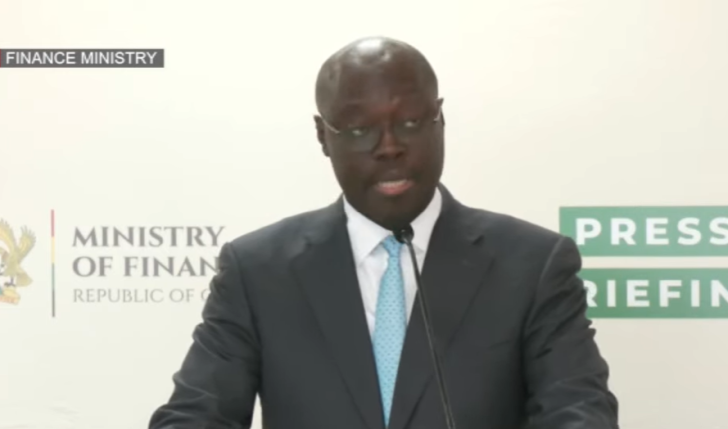
I’m here to deliver a press conference on the cocoa sector reforms and financial viability and long-term sustainability of this sector.
But before then, it’s important for me to, before I go into the main reforms, it’s important for me to give you a bit of a background and a context to the current situation. You recall that on Wednesday, 11th of February 2026, cabinet convened an emergency session to deliberate over development in the cocoa sector. The session considered historical and systemic problems confronting the sector and two key decisions.
The meeting noted the following development in the cocoa sector. First, the 2025-2026 cocoa season began in August 2025 with a producer price of 51,660 Ghana cedis per tonne, calculated at 70% of the gross FOB of 7,200 United States dollars per tonne, using an exchange rate at a time of 10.25 to the US dollar. On the 1st of October 2025, Cote d’Ivoire announced a new producer price, 20% above that of Ghana.
In fact, this decision by the Ivorians, coupled with movement in the exchange rate, resulted in a significant difference in the producer price of cocoa between that of Ghana and Ivory Coast. The price difference had the potential to trigger significant smuggling of Ghana’s cocoa to Cote d’Ivoire. As a result, the producer price review committee on cocoa adjusted the producer price to 58,000 Ghana cedis per tonne to reflect an exchange rate of 11.5 cedis to one US dollar.
The decision by the PPLC to increase the producer price of cocoa made Ghana’s farm gate price competitive and stemmed the potential smuggling of our cocoa beans. From October 2025, unfortunately, the world market price of cocoa started dropping. While the price was declining, cocoa board continued to sell the beans until the price fell below $6,400 per metric tonne, which is the cost of cocoa from the farm gate to the port.
The causes of the situation and the way forward will be my next thing to address. The current situation is largely driven by the unwillingness of buyers to purchase Ghana’s cocoa because it has become uncompetitive and very expensive. Cocoa from other producing countries is now selling at a price significantly lower than that of Ghana’s producer price.
Meanwhile, cocoa board did not have the liquidity to purchase cocoa from farmers and stock for hedging or other trading decisions. This was due to the financing model invented in the year 2024-2025, when the syndicated loan failed. Under that model, the buyers financed the purchase.
By 2022, cocoa board finances had deteriorated badly. It defaulted and restructured the cocoa bills in the year 2023. For the first time in the history of the cocoa industry, in 2023, the annual syndicated suffered significant delays due to the loss of confidence in the Ghanaian economy and the sector.
The first tranche was received on 22nd December 2023, four months after the commencement of the season. Cocoa board projected an output of 800,000 tons and committed 786,672 tons in contracts in 2023 and 2024 crop season. However, actual production was 432,145 tons, a deviation of over 45% from the projected output.
Variation in crop forecasts typically vary between 5% to 15%. Hence, a deviation of 45% was unprecedented and unacceptable. This resulted in a huge rollover contract of about 333,767 tons at an average price of 2,661 US dollars per ton.
This resulted in a loss of over 1 billion US dollars which would have gone to the cocoa farmer or other stakeholders. In 2024, cocoa board could not pay the final tranche of the syndicated loan which was due in July 2024 and received a 70 million US dollar break finance from the Ministry of Finance to avert a default. Despite a commitment to repay the 70 million break finance owed to the Ministry of Finance, cocoa board defaulted, highlighting the dire financial state of the organization at the time.
This debt has since been inherited by the current administration and the current management of the Ghana Cocoa Board. Now, I will take you to the proposed reforms. A careful, and I won’t say proposed reforms, these are reforms that are going to implement immediately.
A careful review of the cocoa sector over the last eight years revealed gross mismanagement which requires immediate and comprehensive reforms to address the challenges in the sector. Cabinet has therefore decided on the following reforms to guarantee a fair price to the cocoa farmer, secure the financial viability of the cocoa sector and ensure the long-term sustainability of the cocoa industry. To bring relief to unpaid cocoa farmers, cabinet has accordingly directed the Ghana Cocoa Board to commence immediate repayment of all affected cocoa farmers.
Two, a new cocoa board bill will be presented to parliament to implement an automatic adjustment of producer price to align with movement in the world market price, exchange rate and other key variables and guarantees a minimum of 70 percent of gross FOB price to be paid to the cocoa farmer. A new financing model for cocoa purchases and related operations with associated benefit for increased processing will be introduced effective 2026-2027 crop season. The current financing model was invented as a necessity after the syndicated loan failed after 32 years of successful implementation and it was proven not to be sustainable.
In fact, it has proven not to be sustainable. The financing model is entirely dependent on a buyer’s willingness to bear the financing cost and to pre-finance the purchase of cocoa. The key motivation for buyers in the previous season was the rollover contract priced at a rate of $2,661 per metric tonne when the existing market price were above $8,000 per metric tonne.
Once the gap between the rollover contract and the market price closes and the majority of the rollover contracts are serviced, the buyer will not be willing to pre-finance the purchase of cocoa crop. Alternatively, the previous syndicated loan model requires that Cocoa Board sells forward most of the raw beans to lock in the contract which repays the loan and serves as collateral as well. This system did not allow Cocoa Board to optimize prices on the market.
In addition, the use of raw beans contract as collateral for the loan meant that Ghana could not optimize its installed capacity for processing. The new financing model will utilize domestic cocoa beans to purchase cocoa. The new financing model will utilize domestic cocoa bonds to purchase cocoa and repay the cocoa proceeds within each crop year.
The bonds will be used to raise a revolving fund for Cocoa Board to turn around at least once during the season. The model will also revive the indigenous licensed buying companies that have been completely thrown out of business as a result of the current financing model. State-owned produce buying company, PBC, will be revived to resume full operations and become the leading licensed buying company in the cocoa sector with immediate effect.
With the new financing model, Cocoa Board can sell beans of any volume to local processing companies to promote value addition and job creation. Cabinets has, however, directed that with immediate effect, the remainder of the beans for the crop year 2025-2026 should be allocated for domestic processing. Cabinet has also directed that beginning from 2026 to 2027 crop season, a minimum of 50% of all cocoa beans should be processed locally.
And this will be part of the Cocoa Board bill going to Parliament. Pursuant to this, the state-owned cocoa processing company, CPC, will be revived as a matter of priority to become the leading processor of Ghana’s cocoa beans. I’ve also, this morning, together with my colleague, the Minister responsible for trade, agribusiness and industry, met with domestic cocoa processors cutting across the private sector, who have indicated that they have the capacity and the willingness to process more than 50% of Ghana’s cocoa beans going forward.
An agreement has been reached on the immediate implementation of this policy. In order to address the indebtedness inherited by the current management of Ghana Cocoa Board, Cabinet has further directed that the Minister responsible for finance, myself, to urgently seek parliamentary approval for the following. One, to convert the legacy debt of about 5.8 billion Ghana cities onto the Ministry of Finance and Bank of Ghana.
Cocoa Board currently owes the Ministry of Finance 3.7 billion Ghana cities, which arose from the conversion of non-marketable cocoa bills into a loan, and the Bank of Ghana another 10-year loan of 1.38 billion Ghana cities. The debt conversion will restore positive equity and boost the international and local market to support the operations of the Ghana Cocoa Board. This will strengthen the balance sheet, obviously, of Ghana Cocoa Board to enable it to implement its new financing model and the reforms.
Cabinet has also directed that, with immediate effect, there should be a transfer of road liabilities worth 4.35 billion Ghana cities to the Ministry of Roads and Highways and the Ministry of Finance. From 2014 to 2024, Cocoa Board owed cocoa contractors from 2014 to 2024. Cocoa Board awarded cocoa contracts of up to 26.5 billion Ghana cities, with 21.5 billion Ghana cities of contracts awarded between 2018 and 2021.
Despite an agreement under the IMF program in 2023 to rationalize Cocoa Board’s commitment of 21.7 billion Ghana cities to 6.9 billion, the previous Board and management of Cocoa Board failed to conduct this exercise. The exercise has subsequently been completed under the supervision of the Ministry of Finance and the Minister responsible for Roads. The Minister of Roads and Cocoa Board jointly conducted this rationalization exercise to reduce the exposure on cocoa roads.
Upon the completion of the exercise, the total exposure of 21.7 billion Ghana cities has since been reduced to 4.35 billion Ghana cities. Cabinet has directed that the liabilities of the 4.35 billion be transferred to the Ministry of Roads and Finance for payment. Cabinet noted that road construction accounts for a significant part of the financial difficulties of Cocoa Board.
Cabinet also noted that road construction accounts for a significant part of the financial difficulties that Cocoa Board is facing at the moment. I made an announcement in the 2026 budget that the Government of Ghana has secured a US$500 million World Bank facility to construct agricultural roads, including Cocoa Roads. This particular intervention will take over the construction of Cocoa Roads going forward.
To ensure accountability and transparency in the management of Cocoa Board and the cocoa sector as a whole, Cabinet also directed the Attorney General to commission concurrent forensic audit and criminal investigation into the activities of Cocoa Board over the last eight years. And I repeat, Cabinet also directed the Office of the Attorney General to commission concurrent forensic audit and criminal investigation into the activities of Cocoa Board over the last eight years. Cabinet has directed the Ministry of Finance to initiate also immediate reforms at Cocoa Board to streamline their operations and cut costs.
Wasteful and uncontrolled expenditure practices are to be curtailed immediately. The world market price has dropped significantly from the average of 7,200 tones to 4,100 per tone, making Ghana’s cocoa beans uncompetitive and creating liquidity challenges. To address this, the Producer Price Review Committee, PPLC, met this afternoon under my chairmanship to assess the challenges facing the sector and review the producer price for the remainder of the 2025-2026 crop year.
In order to cushion the farmer, the PPLC has recommended that the farmer be paid 90% of the achieved gross FOB of 4,200 US dollars per ton to mitigate the adverse impact on the farmer as a result of the fall in the world market price. As a result of that, the PPLC thereby announces that effective today, Thursday, 12 February 2026, the new producer price for the remainder of the 2025-2026 crop season will now be 41,392 Ghana cedis per ton and 2,587 Ghana cedis per bag. This measure has become necessary to reflect the reality of the world market price of cocoa, ensure the injection of immediate liquidity for expedited payment of farmers and guarantee the sustainability of our cocoa sector.
In conclusion, government wishes to convey its sincere appreciation to the Ghanaian cocoa farmer and all stakeholders for their forbearance and sacrifice over the years. Cocoa has always been the mainstay of our economy. I wish to assure them that these reforms will protect the interest of the cocoa farmer and the cocoa sector.
In fact, we strongly believe this will transform the industry. Thank you very much for your attention.
