
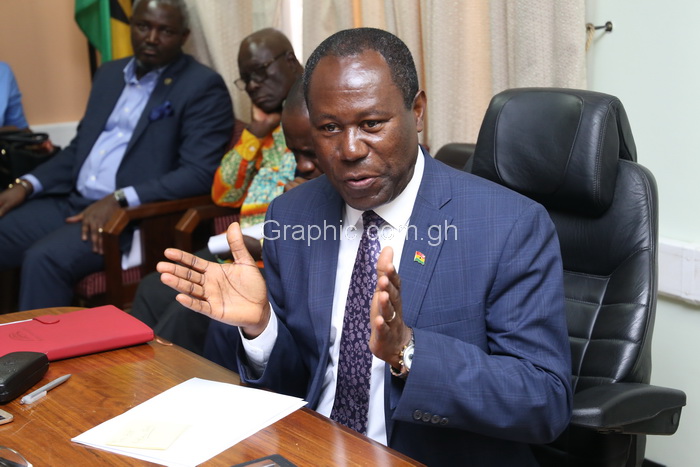
Cabinet has directed the Attorney-General and Minister of Justice to commission a concurrent forensic audit and criminal investigations into the activities of the Ghana Cocoa Board (COCOBOD) between 2017 and 2024.
The highest executive decision-making body of the country, chaired by the President, also directed the Ministry of Finance to initiate immediate reforms at COCOBOD to streamline the operations of the cocoa sector regulator and cut costs.
“Wasteful and uncontrolled expenditure practices are to be curtailed immediately,” the Minister of Finance, Dr Cassiel Ato Forson, who oversees the board, said at a press conference in Accra last Thursday.
The directives follow an emergency Cabinet meeting held last Wednesday to examine challenges besetting the cocoa sector, a major contributor to the country’s Gross Domestic Product (GDP) and about 15 per cent foreign exchange earner for the country.
The Finance Minister, who disclosed this as part of a raft of measures to clean up the cocoa sector, said Cabinet had also directed the transfer of cocoa roads liabilities of GH¢4.35 billion to the Ministry of Roads and Highways.
Transfer
Dr Forson pointed out that between 2014 and 2024, COCOBOD awarded cocoa road contracts of up to GH¢26.5 billion, with GH¢21.5 billion of contracts awarded in 2018/19, 2019/2020, and 2020/2021 crop years.
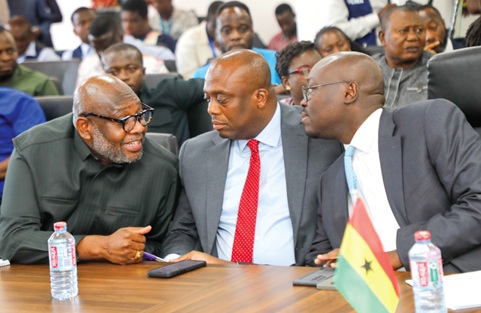
Dr Cassiel Ato Forson (right), Minister of Finance, interacting with Randy Abbey (left), Chief Executive Officer, Ghana Cocoa Board, and Thomas Nyarko Ampem, Deputy Minister of Finance. Picture: ELVIS NII NOI DOWUONA
“Despite an agreement under the International Monetary Fund (IMF) programme in 2023 to rationalise COCOBOD’s commitments of GH¢21.7 billion to GH¢6.9 billion, the previous board and management of COCOBOD failed to conduct this exercise.
“The exercise has subsequently been completed under the supervision of the Ministry of Finance,” Dr Forson revealed.
He added that the Ministry of Roads and COCOBOD jointly conducted the rationalisation exercise to reduce the exposure on cocoa roads.
Upon the completion of the exercise, the total exposure of GH¢21.7 billion has been reduced to GH¢4.35 billion, a liability Cabinet had directed be transferred to the Ministry of Roads and Highways.
Accounts
“Cabinet noted that road construction accounts for a significant part of the financial difficulties of COCOBOD,” the Finance Minister said, adding that the new COCOBOD Bill would prohibit COCOBOD from all such quasi-fiscal expenditures and non-core activities.
He referenced the $500 million World Bank facility announced in this year’s budget and said the government would direct it to the construction of agriculture roads, including roads in cocoa-growing areas.
Liquidity
Dr Forson said the current liquidity challenges of COCOBOD were largely driven by the unwillingness of buyers to purchase Ghana’s cocoa because it had become uncompetitive in the face of significantly lower prices being offered by other cocoa-growing countries.
Meanwhile, COCOBOD did not have the liquidity to purchase cocoa from farmers and stock for hedging or other trading decisions. This was due to the financing model invented in 2024/2025 when the syndicated loan failed.
Under that model, the buyers (off-takers) financed the purchases.
He said by 2022, COCOBOD's finances had deteriorated badly and that it defaulted and restructured the Cocoa Bills in 2023.
“For the first time, in 2023, the annual syndication suffered significant delays due to loss of confidence in the Ghanaian economy.
The first tranche was received on 22nd December 2023, four months after the commencement of the season,” he said.
COCOBOD, Dr Forson said, projected an output of 800,000 tonnes for the 2023/24 crop season, and committed 786,672 tonnes in contracts.
However, actual production was 432,145 tonnes, a deviation of 45 per cent from the projected output and variations in crop forecasts typically varied between five and 15 per cent. Hence, the 45 per cent deviation was unprecedented.
Rollover
“This resulted in huge rollover contracts of 333,767 tonnes at an average price of $2,661 per tonne,” he said and that “This resulted in a loss of over $1 billion, which would have gone to cocoa farmers and other stakeholders.
Dr Forson said in 2024, COCOBOD could not pay back the final tranche of the syndicated loan, which was due in July 2024, and received a $70 million bridge financing from the Ministry of Finance to avert a default.
Despite a commitment to repay the $70 million debt owed the Ministry of Finance, COCOBOD defaulted, highlighting the dire financial straits of the organisation at the time.
“This debt has since been inherited by the current management of COCOBOD,” Dr Forson pointed out.
