President Mahama earns 68 per cent approval as unemployment ranks Ghana’s top concern - IEA survey
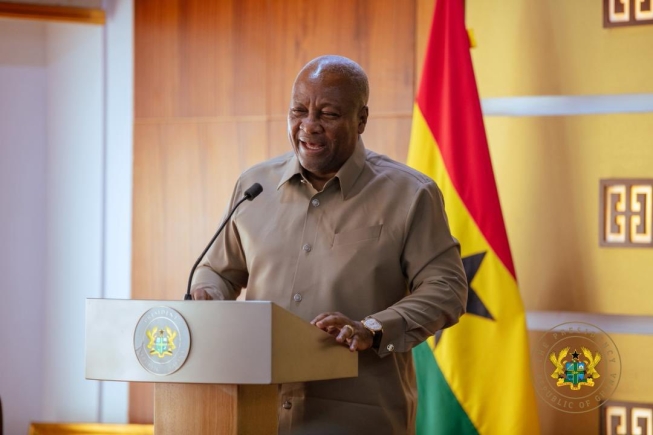
President John Dramani Mahama has recorded a 68 per cent approval rating one year after taking office, according to a nationwide survey undertaken by the Institute of Economic Affairs (IEA).
The poll, issued on Tuesday, February 11, 2026, assessed public views on President Mahama’s performance and the country’s most pressing challenges. It was conducted in December 2025 across all 16 regions with a sample of more than 1,000 respondents.
According to the IEA, 68 per cent of respondents approved of the way President Mahama was handling his job.
Twenty-two per cent disapproved, while 10 per cent expressed no opinion.
The institute said the figures show a wide gap between approval and disapproval during the President’s first year in office.
The survey also found unemployment to be the most pressing national issue. Forty-six per cent of respondents identified joblessness as the country’s top concern, the highest share recorded for any issue in the poll.
Illegal mining [galamsey], ranked second, with 30 per cent citing it as a major problem. The IEA said concerns about environmental damage and water pollution continue to shape public opinion on the issue.
Corruption, which has often ranked high in past surveys, was mentioned by 9 per cent of respondents. Another 8 per cent cited the general state of the economy.
Other issues drew lower responses. Housing accounted for 2.6 per cent, transportation 1.5 per cent, and other concerns 3.2 per cent. The data show employment and environmental matters ranking ahead of corruption in the current public perception.
The survey also reported concern about the rising cost of living. Seventy-one per cent of respondents said they were very concerned about the cost of food and consumer goods, while 20 per cent said they were somewhat concerned. Nine per cent indicated no concern.
The IEA said the findings form part of its periodic national opinion research aimed at gauging governance performance and public priorities. The institute said the results offer insight into public expectations as the administration enters its second year in office.
No margin of error was disclosed in the release.