
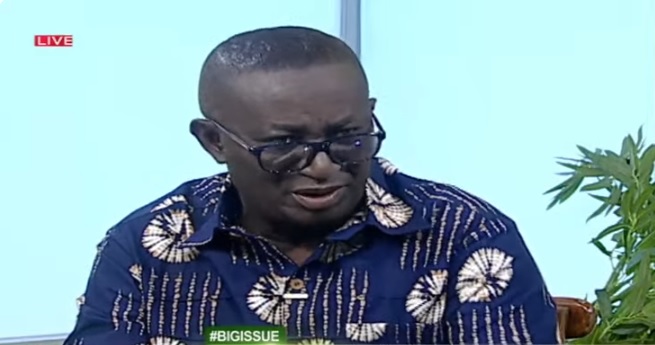
A former New Patriotic Party Member of Parliament for Asante Akyem North, Andy Appiah-Kubi, has proposed a lottery-based voting method for political party primaries, a move that has stirred debate over internal party democracy.
Mr Appiah-Kubi, who lost the Asante Akyem North seat in the 2024 general election, presented the proposal during a televised discussion on Joy News on February 11, 2026.
He argued that inducement persists where delegates are known before voting.
Under the proposal, all registered party members in a constituency who have paid their dues would qualify to participate.
Only those who pick a yes ballot through a raffle draw at the polling station would then vote, while those who draw no ballots would leave without voting.
“Let us have 6400 no ballots, 600 yes ballots. Mesh them up,” Mr Appiah-Kubi said. “So that nobody going into the centre could be identified as a legitimate voter.”
The idea drew criticism from other panellists. Mr Inusah Fuseini, a former Minister of Lands and Natural Resources, rejected the suggestion and described it as unconstitutional.
“You cannot reduce public elections into lotteries,” Mr Fuseini said. “It is to fly in the face of democratic principles. How do you campaign? Who do you campaign to?”
Mr Fuseini, who served on the National Democratic Congress committee that examined vote-buying claims during the recent Ayawaso East primary, said voting is a constitutional right which cannot be restricted by chance.
The discussion followed controversy over the National Democratic Congress parliamentary primary in Ayawaso East held on February 7, 2026, where widespread vote-buying allegations involving candidates were reported.
Mr Appiah-Kubi, who represented Asante Akyem North from 2017 to January 2025, said he spent between GH¢3 million and GH¢4 million to secure his seat.
He argued that identifying delegates ahead of voting creates conditions where financial inducement becomes unavoidable.
“Wherever the money comes from, it will be expended,” Mr Appiah-Kubi said. “As long as we are able to identify delegates, they will be influenced.”
His remarks form part of wider calls for changes to electoral practices following claims that parliamentary races now cost millions of cedis, placing candidates without strong financial backing at a disadvantage.
Also on the panel, Mr Joseph Oti Frimpong, Programmes Officer at the Centre for Democratic Development (CDD-Ghana) and Coordinator of the CODEO Secretariat, said his organisation has submitted a draft campaign financing bill to the Attorney General's Department and plans to conduct public consultations in 10 regions within the next fortnight.
Mr Frimpong called for internal party primaries to be brought under the Political Parties Act, which currently only regulates public elections.
Ms Esther Tawiah, Executive Director of the Gender Centre for Empowering Development (GenCED), who also appeared on the programme, warned that the current system disproportionately excludes women and young people who lack access to substantial funding.
"One of the women mentioned to contest as a woman organiser, she had to spend over five hundred thousand Ghana cedis," Ms Tawiah said.
During the discussion, panellists referenced the Constitutional Review Committee's recommendations, which include an independent registrar for political parties, campaign period limits, spending caps for candidates, and mandatory financial disclosure.
Mr Appiah-Kubi maintained that existing laws are adequate when applied as intended.
“The solution does not lie in the propagation of more laws,” Mr Appiah-Kubi said. “The process of ensuring the selection system is without influence is what we have to work towards.”
