
For decades, experts have maintained that cocoa, Ghana’s largest agricultural export, cannot thrive in the savannah conditions of northern Ghana.
However, that long-standing belief is now being challenged by a groundbreaking discovery at Salnaayili, a community in the Nanumba North Municipality in the Northern Region, where cocoa trees are flourishing in the open savannah landscape.
The sight of the plantation alone is enough to dispel the long-held doubts about the crop’s survival and viability.
The breakthrough is credited to Mohammed Yinchala, a farmer who began cocoa cultivation in 2012 as a small experimental plot.
Encouraged by early success, he gradually expanded the farm to four acres.
However, the journey encountered a setback when two and a half acres were razed by wildfire, leaving only one and a half acres remaining, which currently yields an average of four bags per harvest.
Experiment
Sharing his experience, Mr Yinchala said he started the farm as an experiment in 2012 to see if cocoa could thrive in the north.
He said, “gradually, i expanded it to four acres, but unfortunately, wildfire destroyed two and a half acres. Now, the remaining one and a half acres are doing very well, and we are already harvesting about four bags each season”.
With his experience on the farm, he said he believed cocoa production could be commercialised in the north if given the right attention and resources.
On the challenges, the farmer indicated that he often struggled with limited technical knowledge, especially on modern cocoa farming techniques and a lack of farm implements and tools, making manual work laborious and slow.
Assessment
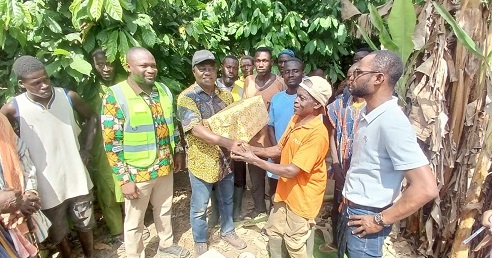
The Ghana Cocoa Board (COCOBOD), whose attention has been drawn to the discovery, dispatched officials to visit the plantation to assess its viability for commercial cocoa production last Saturday.
As a gesture of motivation, COCOBOD presented the farmer with some cocoa products, chemicals and an undisclosed sum of money.
The team further revealed that the Chief Executive Officer of OCOBOD, Dr Randy Abbey, had pledged to provide the farmer with a motorbike and build a house for him on the farm to support expansion.
Speaking to the media during the visit, the Deputy Chief Executive Officer of COCOBOD in charge of Agronomy and Quality Control, Dr Francis Baah, hinted at plans by COCOBOD to deploy experts to study the soil, topography and climatic suitability for large-scale cultivation.
He said COCOBOD viewed this as a major discovery and would do everything possible to support farmers to commercialise the cash crop in the area.
“We are very amazed by your discovery, you are the Tetteh Quarshie of our time. For years, we believed cocoa could not survive here, but today you have rewritten history, we will support you and help others who are ready to venture into cocoa cultivation,” he said.
Honour
Dr Baah indicated that COCOBOD intended to honour Mr Yinchala at the forthcoming National Farmers’ Day celebration for his hard work, commitment and pioneering contribution to northern cocoa cultivation.
For his part, the Regent of the Nanung Traditional Area, Nyelinboligu Naa Yakubu Andani Dasana, welcomed COCOBOD’s decision to assess the area for commercial production.
He noted that the land was fertile and available in large quantities enough to support massive cocoa cultivation should the project move into full-scale development.
Ripple effect
In a ripple effect, Mr Yinchala’s achievement has motivated neighbouring farmers. Just beside his plantation, another farmer, Abdul-Rahaman Alhassan, has already established a five-acre cocoa field.
Although planted barely two years ago, the young cocoa plants are showing strong growth and early signs of promise.
The natural environment of the area appears equally supportive.
The farm lies within dense vegetation with tall canopy trees, and the soil remains moist even during the dry season due to its proximity to the Oti River, providing favourable agroecological conditions for the cash crop.
Writer’s email:
