
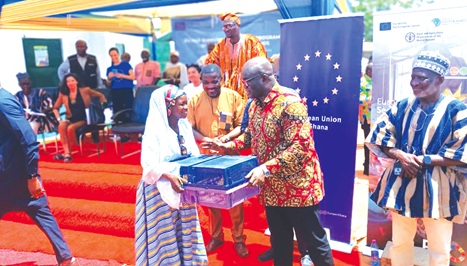
Dormaa Central boosts agriculture, expands agro-processing to drive local economy
Agriculture and agro-processing have emerged as key drivers of economic growth in the Dormaa Municipality of the Bono Region.
The sectors employ more than 60 per cent of the local workforce, sustaining livelihoods across communities.
In that regard, the Municipal Assembly has intensified efforts to strengthen the sectors through targeted interventions, including the distribution of 10,000 birds under the Nkoko Nkitinkiti programme to boost poultry production.
In addition, 10,000 improved coconut seedlings have been supplied to farmers to enhance crop diversification and long-term productivity, while continuous training in climate-smart agricultural practices contributed to improved yields during the 2025 farming season.
Accounting tour
The Municipal Chief Executive (MCE), Dominic Adomah Ameyaw, made these known when he addressed the chiefs and people of the area during an “Accounting to the People” tour at Dormaa-Ahenkro last Wednesday.
His presentation covered all sectors of the economy, including health, education, agriculture, infrastructure and social programmes.
Prior to the durbar, Mr Ameyaw led the Bono Regional Minister, Joseph Addai Akwaboa, on an inspection tour of ongoing projects in the municipality.
Investment
He underscored the need for the assembly to deepen investment in agriculture and agro-processing, strengthen public-private partnerships and enhance access to credit to sustain economic growth.
Mr Ameyaw explained that the assembly had also promoted small-scale enterprise development as part of measures to add value to agricultural produce and strengthen the local economy.
The DCE said the assembly had rolled out initiatives such as the Poultry Business Clinic and Municipal Egg Day to promote agribusiness.
Maternal mortality
On health, Mr Amenyew stated that institutional maternal mortality reduced significantly from 76.51 per 100,000 live births to 36.09 per 100,000 live births in 2025.
He said the improvement had been supported by investments in health infrastructure, including the construction of Community-based Health Planning and Services (CHPS) compounds at Besease and Duasidan.
Other projects Mr Amenyew mentioned included a 30-bed capacity ward at Antwirifo Health Centre and a 15-bed capacity ward at Asikasu, Nsuhia CHPS compound and the completion of a maternity block at Asikasu.
Roads
He said the assembly had rehabilitated more than 35 kilometres of roads, completed a 0.55-kilometre pedestrian walkway and installed traffic lights in Dormaa-Ahenkro to improve safety.
Mr Amenyew stated that the assembly had installed 13 hand pumps and 10 mechanised boreholes to improve access to safe drinking water.
He said youth employment initiatives led to the recruitment of 235 young people into various modules, with additional skills training for 200 youth and apprenticeship support for 60 individuals.
Mr Ameyaw, however, highlighted challenges such as erratic rainfall, lack of irrigation facilities, limited access to agricultural financing and high input costs, particularly in the poultry sector.
Development projects
For his part, the Regional Minister, Mr Akwaboa, said the government had invested heavily in development projects, especially roads, across the region.
"The projects the current government has done in one year is unprecedented; this is an accountability series.
This year, we have started some projects.
Next year we will account to the chiefs and people the project we have done.
Writer's email:
