
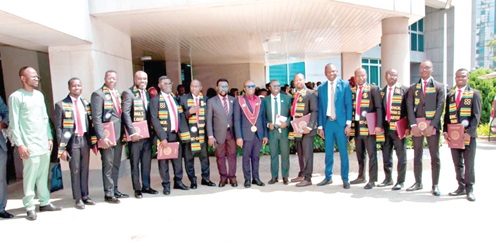
Engineers charged to advance excellence through renewed commitment
The President of the Institution of Engineering and Technology, Ghana (IET-GH), Henry Kwadwo Boateng, has charged newly inducted engineers to renew their collective commitment to advance excellence for a changing world.
“Let us advocate for stronger academic systems, credible professional pathways, and the strategic involvement of engineers in national development.
“With unity of purpose, dedication to competence, and an uncompromising respect for engineering standards, we will not only adapt to the changing world, but we will shape it,” Mr Boateng said at the induction of 210 engineering professionals.
Pride
The day, he said, was a moment of pride not only for the inductees who had worked diligently to meet the standards of the profession, but for all who continue to uphold the values of integrity, competence, and service to society.
“This year’s theme, ‘Engineering Excellence for a Changing World,’ could not be more fitting.
We live in an era of rapid transformation—technological, economic, environmental, and societal.
Every sector of our national development agenda is being reshaped by new demands, new risks, and new expectations. In the midst of this change, engineering professionals continue to stand at the centre of Ghana’s progress,” he said.
Mr Boateng said that as the government pursued its reset agenda, focusing on economic stability, infrastructure renewal, energy expansion, digitalisation, and sustainable development, the role of engineering had never been more critical.
“The success of this national reset depends not only on policies and financing, but on the quality of the people who will design, build, maintain, and manage the systems that power our nation.
Position
“We, as engineers, must therefore position ourselves as strategic partners in national transformation.
Our contributions must go beyond technical execution; they must extend to innovation, ethical leadership, and evidence-based decision-making.
Ghana’s development vision simply cannot materialise without competent engineering professionals at the forefront,” he said.
However, he said, “If we are to deliver excellence, we must begin by asking ourselves an important question: How well have we been trained to meet the expectations of this changing world?
The truth, the IET-GH President said, was that engineering excellence could not be achieved with inadequate academic structures, congested workshops, outdated laboratories, or theoretical teaching with minimal practical exposure.
“Universities must not treat engineering programmes merely as avenues for internally generated funds. Instead, they must serve as centres of rigorous, hands-on, industry-aligned training.
“We must advocate for a stronger regulatory oversight of engineering education, ensuring that institutions that run engineering programmes do so with the right infrastructure, qualified faculty, appropriate student-to-machine ratios, and modern teaching methodologies.
The goal should be clear: to produce engineers who are not half-baked, but fully equipped to uphold safety, innovation, and professionalism in the national interest,” he said.
Complement
He said to complement quality training, the Engineering Council must also accelerate the development of clear career progression pathways, especially for the engineering craft, technicians, and technologists who form the backbone of the engineering ecosystem.
A structured pathway, he said, would not only boost morale, but would also create opportunities for skills development, mentorship, certification and professional mobility.
Excellence, he said, could not be the preserve of a few; it must be a continuous ladder accessible to all categories within the profession.
“To our new inductees, today marks the beginning of a profound responsibility.
You are joining a profession where public safety, national trust, and ethical standards are paramount.
As you take the oath, remember that society expects you to be problem solvers, innovators, and custodians of engineering standards.
“The world is changing quickly to embrace digital skills, sustainability principles, multidisciplinary collaboration, and lifelong learning.
Excellence is not an event; it is a discipline,” he said
