
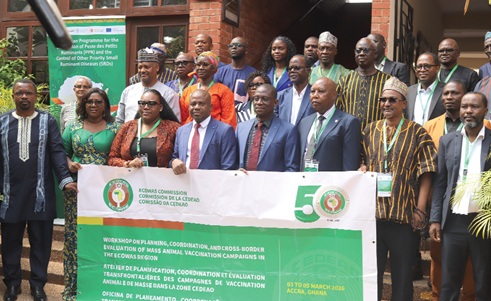
Experts in ECOWAS meet to plan for cross-border animal vaccination campaign
The Economic Community of West African States (ECOWAS) has begun a high-level regional workshop in Accra aimed at strengthening cross-border mass animal vaccination campaigns to control and eradicate transboundary animal diseases in West Africa and the Sahel.
The three-day ‘Cross-border Planning, Coordination and Evaluation Workshop’, which started last Tuesday, among other things, reviewed vaccination campaigns conducted between 2023 and 2025, as well as proposed priority actions to improve disease control across member states.
Participants also discussed the rollout of a new “Episystem Approach”: that is, mass vaccination targeting transhumance corridors and livestock trade routes where animals naturally mix across borders.
The objectives of the workshop included harmonisation of the 2026 regional vaccination calendar to ensure simultaneous coverage across countries; transitioning of member states from control phase to eradication phase of PPR management, and mobilising sustainable financing through a multi-partner approach involving institutions such as the African Development Bank, the European Union (EU), Swiss Cooperation, ECOWAS member states and producer associations.
The workshop was organised by the ECOWAS Commission through the Regional Animal Health Centre (RAHC).
PPR
A representative from the ECOWAS Regional Animal Health Centre (CRSA), Dr Eugene Koffi, said the workshop was timely as the livestock sector continued to be affected by transboundary animal diseases such as Contagious Bovine Pleuropneumonia (CBPP), Peste des Petits Ruminants (PPR), Foot-and-Mouth Disease (FMD) and Rift Valley Fever.
He said the workshop was focused on the eradication of PPR, a highly contagious viral disease that could affect sheep and goats.
The Africa Regional Representative of the World Organisation for Animal Health (WOAH), Simon Kihu, said eradicating PPR was not only a veterinary obligation but an investment in human development, gender equity, employment and social stability.
“The 2030 eradication target is ambitious, but it is achievable if we act with discipline, coordination and solidarity,” he said, reaffirming WOAH’s commitment to supporting the goal of a PPR-free West Africa.
The Disease Control and Management Coordinator at the Pan-African PPR Secretariat, Dr Jean-Marc Feussom, said inter-regional synergies were not only essential for disease control, but for supporting the African Continental Free Trade Area (AfCFTA).
He called on participants to translate the Episystem approach into concrete operational plans, expressing the African Union's support for the RAHC to ensure the eradication of the disease.
Ghana’s commitment
In a speech read on his behalf, the Minister of Food and Agriculture, Eric Opoku, described the workshop as timely and strategic, given the persistent threats posed by transboundary animal diseases to trade, livelihoods, public health and regional stability.
He called for strengthened collaboration among stakeholders to improve the impact of vaccination campaigns.
Local insights
Providing a national perspective, the Deputy Chief Veterinary Officer at the Ministry of Food and Agriculture, Dr Fenteng Danso, said studies conducted had identified PPR hotspots in these five northern regions, the Upper East, Upper West, North East, Savannah and Northern regions, where vaccination had been done in 2023.
He said routine vaccinations were conducted for the rest of the country to improve disease monitoring and response.
The President of the Ghana National Association of Cattle Farmers, Imam Hanafi Sonde, said farmers continued to suffer annual losses due to PPR and related diseases, stressing the urgency of rapid and effective vaccination.
He proposed training for youth from pastoralist communities as veterinary aides to support vaccination in remote areas while pledging the association’s commitment to work with the Veterinary Services Directorate and other stakeholders to eliminate the disease.
