

From 3,000 to 1,650 Cubic Meters per person: Minister outlines moves to restore rivers, avert water stress
Ghana’s per capita renewable water availability has declined sharply from about 3,000 cubic metres per person per year in the 1960s to just 1,650 cubic metres.
The Minister of Works, Housing and Water Resources, Kenneth Gilbert Adjei, who made this known, stressed that the decline, driven by population growth, urbanisation, pollution and climate change, called for bold reforms in river and water management to secure the country’s future.
He announced that the government would enact a Legislative Instrument on Buffer Zones to legally protect riparian areas and prevent encroachment.
Mr Adjei said a revised National Water Policy would also be rolled out to align with the Sustainable Development Goal Six (SDG 6), climate commitments and development priorities.
“If not reversed, Ghana risks slipping into the category of water-stressed countries.
This means that water security will no longer be guaranteed and the competition for water between domestic, industrial and agricultural users will intensify,” Mr Adjei stated at the launch of the country’s maiden celebration of World Rivers Day in Accra yesterday.
Rivers Day
World Rivers Day, established in 2005, is an annual global celebration held on the fourth Sunday of September to highlight the importance of rivers and raise awareness about the need to protect and conserve them.
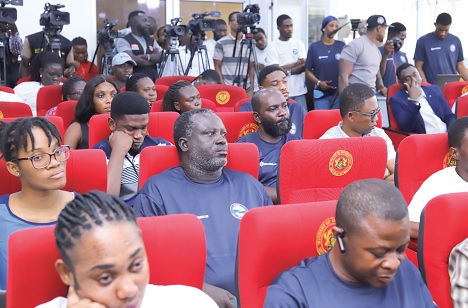
Participants in the launch of the World Rivers Day 2025
The commemoration will be spearheaded by the Water Resources Commission on the theme; “Our Rivers, Our Future.”
It will feature advocacy, media engagement, river tracing, buffer restoration, data gathering, signage erection, and a climax event, uniting stakeholders to highlight rivers’ benefits and collective protection.
The stakeholder institutions involved in its organisation include the Ghana Water Limited (GWL), Ghana Hydrological Authority (GHA), Environmental Protection Authority (EPA), Forestry Commission, Coalition of NGOs in Water and Sanitation (CONIWAS) and the Ghana Police Service.
Policy actions
Mr Adjei stressed that “Laws must not remain on paper. They must bite. Enforcement will be uncompromising, and offenders who pollute or destroy rivers will face strict penalties,” he stressed.
He said the government would intensify the fight against illegal mining, describing it as the single biggest threat to rivers, adding that beyond enforcement, alternative livelihoods would be provided for the youth engaged in the activity.
Mr Adjei described rivers, including the Volta, Pra, Ankobra, White Volta, Black Volta, Tano and Densu, as central to national life, powering hydropower, irrigation, fishing and domestic supply.
However, he lamented that they were under siege from illegal mining, deforestation, pollution, sand winning and climate change impacts.
Big Push Agenda
He further announced a Big Push Agenda for Water Infrastructure, covering the expansion and rehabilitation of water treatment plants, upgrading of distribution networks to reduce leakages and acceleration of rural water supply to vulnerable communities.
Financing would combine public investment, private participation and blended finance.
On climate adaptation, the minister said integrated water resources management would be promoted, with investments in reforestation, wetlands protection, early warning systems and community-led conservation.
“When citizens see rivers as sacred treasures, not dumping sites, we will have won half the battle. Our rivers are not just sources of water.
They are ecosystems that sustain life. Protecting them means protecting our future,” Mr Adjei added.
Central role
The Head of Licensing and Compliance Directorate of the Water Resources Commission, Dr Bernadette Adjei, representing the Acting Secretary of the commission, underscored the central role rivers played in sustaining agriculture, industry, culture, religion and community life.
However, she also cautioned that rivers faced grave threats, including illegal mining, pollution, deforestation, unsustainable urban activities, and climate change.
She therefore emphasised that the celebration was both a commemoration and a national call to action.
“It is a reminder of our shared responsibility to protect, restore and manage our rivers wisely for the present and future generations.
Let us renew our commitment to protecting our rivers.
Together, government, traditional authorities, the private sector, schools, the youth and local communities can all ensure that rivers remain clean, healthy and vibrant for all,” she said.
