
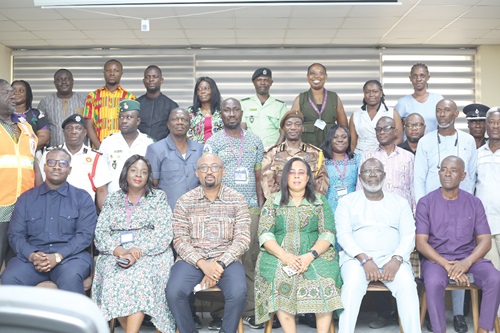
Greater Accra to partner VRA on emergency preparedness, environmental safety
The Volta River Authority (VRA) has organised an emergency preparedness and environmental management workshop for the Greater Accra Regional Coordinating Council as part of efforts to sensitise local assemblies about emergency preparedness.
It focused on the authority’s emergency preparedness plan and environmental management plan, two frameworks designed to enhance resilience, ensure public safety, and promote environmentally sound practices in the management of the country’s major hydroelectric facilities.
Last Wednesday’s stakeholder workshop was organised for selected metropolitan, municipal and district assemblies (MMDAs) in the region.
It brought together district chief executives (DCEs), security personnel, officials from the VRA, and institutional heads, among others.
At the meeting, the Greater Accra Regional Minister, Linda Ocloo, assured the management of the VRA of the Regional Coordinating Council’s (RCC) full support in implementing emergency preparedness and environmental management strategies related to the Akosombo and Kpong dams.
She emphasised the importance of institutional collaboration in strengthening disaster response mechanisms and safeguarding communities against the potential impact of hydro dam operations.
“This workshop could not have come at a better time.
The consequences of such events underscore the urgent need for coordinated emergency preparedness and environmental management strategies.
Therefore, this gathering is not only timely but essential,” she said.
Reminder
Ms Ocloo, who is also the Member of Parliament (MP) for Shai-Osudoku in the region, said the recent controlled spillage of the Akosombo Dam served as a sobering reminder of the vulnerabilities in emergency coordination, with several districts in the Greater Accra Region gravely affected.
She reiterated that the emergency preparedness plan provided a clear blueprint for annual engagement in 10 potentially affected districts.
She called on stakeholders to use the workshop as a platform to understand VRA’s environmental strategies and to explore ways to support them.
The regional minister stressed that the RCC was not only committed to supporting the implementation of both plans but would also play an active role in ensuring that lives and property were protected.
“I urge all participants to take full advantage of this workshop.
Let us exchange ideas, ask critical questions, and strengthen our collective ability to respond to emergencies and manage our environment responsibly,” she added.
Operations
The Corporate Communications Manager of VRA, Francis Abban, explained that since 2011, the VRA had annually engaged stakeholders across operational areas, from the Eastern and Volta regions to Greater Accra, to ensure that all parties understood their roles in the event of an emergency.
Mr Abban stressed that the sensitisation helped to mitigate risks associated with potential spillage from the Akosombo Dam, especially across the 10 identified at-risk districts in three regions.
He clarified that VRA’s emergency scenarios were based on inundation maps, and emergencies were classified by severity, with communication protocols at each level.
Currently, Mr Abban said there was no imminent threat, and the dam’s water level remained within safe limits, and assured the public of VRA’s commitment to transparency and timely communication should any situation arise.
“We are an organisation that clarifies and shares information in real time.
Just as we have explained to you the objective of this engagement today, should there be a need for us to communicate, should there be an emergency in sight, we will let the public know.
At this minute, there is no cause for alarm whatsoever,” he said.
