
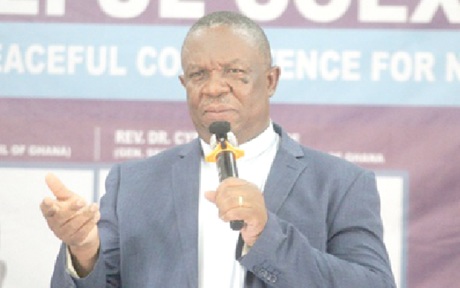
Kick out systemic discrimination, economic disparity - Christian Council urges on World Day of Social Justice
The Christian Council of Ghana (CCG) has called on the government and all stakeholders in nation-building to work concertedly to rid the society of systemic discrimination, economic disparity and bad governance, among others, that hinder inclusive socio-economic prosperity.
In a statement to commemorate the United Nations (UN) World Day of Social Justice, the CCG prayed that the world, especially the Global South, would soon experience true freedom and justice anchored on collective welfare and not on the welfare of a few privileged people
.The CCG, in a statement signed by its General Secretary, Rev. Dr Cyril G. K. Fayose, commended President John Dramani Mahama for his commitment to the promotion of social justice through policies such as the National Apprenticeship Programme, MahamaCares (Ghana Medical Trust Fund), 'No-Fees-Stress' Initiative, Free Tertiary Education for Persons with Disabilities (PWDs, Free Sanitary Pads Distribution, Adwumawura Programme, Expansion of LEAP Programme, Free Primary Healthcare and others.
It stated that “while these policies are good, it is their effective and just implementation that will go a long way to bless the targeted beneficiaries to promote a just, progressive and prosperous society for all and not just a few.”
Collaboration
The council said in spite of all the commendable policies, the government alone would not be able to adequately promote social justice and therefore called on the religious community and development partners such as the United Nations (UN), to work collaboratively to promote social justice, especially in regions where race, gender, sexuality and economic status had become barriers to accessing basic rights, opportunities and social services that enhanced the welfare of God’s people.
The CCG also prayed that the issue of “no bed syndrome”, which it described as “an affront to social justice”, would be a thing of the past, saying “every Ghanaian or resident of Ghana deserves emergency care to stay alive to attain their God-given potential.”
Theme
On the theme, “Empowering Inclusion: Bridging Gaps for Social Justice”, the CCG said it stood in solemn solidarity with the global call to dismantle barriers of exclusion, inequality and marginalisation.
It added that it was not just merely a civic duty for it, but as a moral duty and profound expression of faith in the God who declares: “Righteousness and justice are the foundation of your throne; love and faithfulness go before you” (Psalm 89:14).
The statement said the theme also resonated deeply with Ghana’s cherished motto, “Freedom and Justice,” in its Coat of Arms, saying, “Our forebears, emerging from colonial oppression, inscribed these words as a covenantal aspiration: true freedom from bondage and just treatment for every citizen as image-bearers of God, regardless of socioeconomic status and religious background.”
Coming on the third day of Lent, a period which calls for penitence, reflections, deep piety and beneficence, the CCG called on Ghanaians to allow the principle of God’s word reflected in Isaiah 58:1-12, inspire them to do right to all persons, especially the poor, the vulnerable and the socially disadvantaged.
The Christian Council also wants the day celebrated worldwide under the auspices of the UN, to bring humanity closer to the divine calling that enjoined man to be each other’s keeper.
The ecumenical body invoked the blessings of God on the government, the people of Ghana, the UN family in Ghana and globally, “and make our world more equitable, just, peaceful and prosperous.”
Background
In June 2008, the UN instituted February 20 as the World Day of Social Justice.
It was instituted to put the spotlight on the need for full and productive employment for social development and its interrelation with poverty eradication and social
inclusion.
It also aims to establish a people-centred framework for social development in a world where basic needs were still not being met, where poverty persisted and where unemployment and social exclusion were rising.
