

The Minister of Health, Kwabena Mintah Akandoh, has directed all health facilities across the country to strictly enforce security and identification protocols to prevent incidents such as baby theft and baby swaps.
The directive, which he said was already in force, must be adhered to strictly to safeguard patients, staff and the public.
The Health Minister reiterated the directive when he visited the Mamprobi Hospital in Accra yesterday, following a baby theft at the facility.
As an additional measure, the Minister of Health introduced a new directive requiring name tags for mothers and their babies to be removed only at the security gate when exiting the facility, after all discharge procedures had been completed.
“We don’t give instructions for the sake of it. These directives are meant to protect all of us. We must not wait for incidents of this nature before we heighten measures that have already been clearly communicated,” the Minister of Health said.
Stronger surveillance
Addressing the management and staff of the hospital, Mr Akandoh said he had directed the Director-General of the Ghana Health Service (GHS) to ensure that every health facility established a strong working relationship with its nearest police station.
Under the arrangement, he said, police officers were expected to patrol health facilities regularly or be available to respond promptly when contacted.
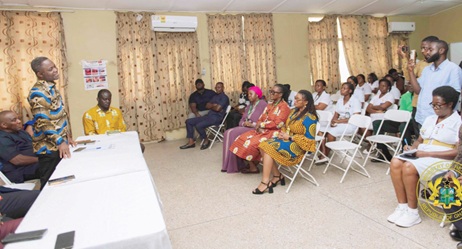
Kwabena Mintah Akandoh, Minister of Health, in a closed-door meeting with the staff of the hospital
Mr Akandoh stressed the mandatory installation and functionality of closed-circuit television (CCTV) cameras in all health facilities, stating that the directive had long been circulated nationwide.
“Every health facility must have working CCTV cameras; this has been communicated long ago,” he stated.
Name tags
The Minister of Health said it was unacceptable for hospital staff to fail to wear name tags, urging them to have them on at all times.
“No staff member should be on duty without proper identification.
At this point, not wearing your name tag is a serious offence. If anything happens and you fail to enforce this directive, you will be dealt with,” he warned.
Explaining the new measure of name tags for mothers and babies, Mr Akandoh said: “This is one of the ways we can prevent baby theft and baby swaps. Tagging babies and parents is extremely important under these circumstances.”
Investigations ongoing
Responding to questions on whether any hospital staff had been arrested to assist with the investigation, Mr Akandoh said the police were on top of the issue and urged the public to exercise patience.
“We cannot pre-empt the outcome.
Whether anyone will be sanctioned or held responsible will depend on the findings,” he said.
The Health Minister gave an assurance that the government would work with health facility managers to ensure that all directives were fully implemented to restore confidence in the health system and prevent the recurrence of such incidents.
Reforms
Beyond security, Mr Akandoh suggested other reforms in health, which include the placement of suggestion boxes at strategic locations to receive complaints and improved aesthetics within hospital environments.
“I don’t want to visit any health facility and see bare land with red soil.
If you cannot pave it, at least plant grass or flowers to beautify the place,” he said.
Mother, baby
The Health Minister later visited the mother and her baby, who were receiving care at the Korle Bu Teaching Hospital.
He assured them of the ministry’s resolve in collaboration with relevant stakeholders to take the necessary steps to prevent a recurrence of such incidents.
The father of the child, Mohammed Agyemang, who spoke to the media, expressed gratitude to the Minister of Health and other officials for their intervention and support, and said the most important outcome was the recovery of the child.
He called for the law to be firmly applied to bring an end to such incidents, stressing that although it was their first direct experience, reports of similar cases had become too frequent.
