


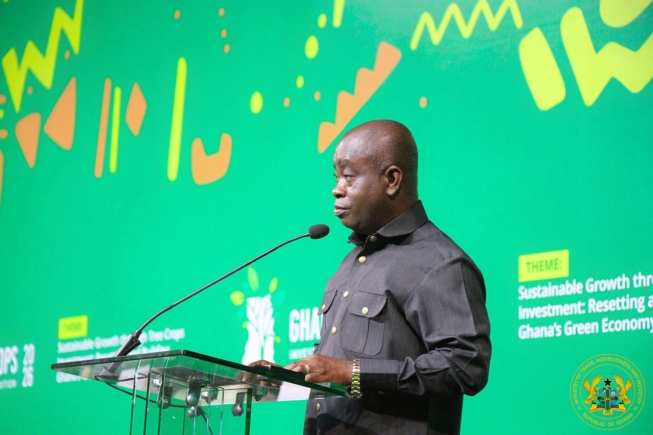
Invest in Ghana’s tree crops now — Deputy Minister tells global investors
Ghana is positioning its tree crops sector as a prime destination for large-scale agribusiness investment, with the Deputy Minister for Trade, Agribusiness and Industry, Sampson Ahi, declaring that the time for private sector participation is now.
Addressing participants at the maiden Ghana Tree Crops Investment Summit & Exhibition (GTCIS–2026), the Deputy Minister said the country’s traditional reliance on exporting raw commodities was giving way to a deliberate push towards value addition and industrial expansion.
He described Ghana’s tree crops industry — spanning cocoa, rubber, cashew, shea, oil palm and coconut — as one of Africa’s most compelling agribusiness frontiers, arguing that the real gains lay beyond primary production.
According to him, the sector is now focused on capturing a greater share of the over $300 billion global processed commodities market, rather than remaining at the lower end of the value chain.
While acknowledging that Ghana already earns billions of dollars annually from tree crop exports, Mr Ahi stressed that expanding domestic processing capacity presented the most significant opportunity for growth, job creation and industrial transformation.
He cited a series of policy interventions designed to de-risk private investment and guarantee raw material availability. Among them is the ban on the export of raw rubber lumps to ensure sufficient supply for local processors. He also highlighted the government’s 50 per cent local cocoa processing target, supported by structured supply arrangements through the Ghana Cocoa Board.
These measures, he noted, are intended to make processing ventures more predictable, secure and financially viable for investors.
The Deputy Minister further referenced the government’s “Feed the Industry” programme, which aggregates output from more than two million farmers through cooperatives and out-grower schemes. He said the model improves traceability and sustainability compliance, while ensuring consistent supply — a prerequisite for accessing premium markets in Europe and North America.
Beyond raw material security, Mr Ahi underscored Ghana’s broader competitive advantages, including political stability, a robust legal framework, efficient port infrastructure and a young, English-speaking workforce.
He also pointed to Ghana’s role as host of the Secretariat of the African Continental Free Trade Area (AfCFTA), which provides businesses with strategic access to a continental market of 1.3 billion people.
Seeking to reassure potential investors, Mr Ahi said the Ministry’s agribusiness unit stands ready to facilitate entry and expansion by fast-tracking permits, supporting land acquisition processes, linking investors with farmer cooperatives and assisting with financing discussions. He indicated that the Ministry aims to help investors move projects from agreement stage to groundbreaking within six months.
At the summit, representatives of financial institutions, presenting on the theme “unlocking finance for the Tree crop sector”, pledged their support for investment in the industry. They said efforts would focus on improving competitiveness, easing financing constraints and reducing the financial burden on farmers, among other interventions.
The summit marks a renewed push by government to reposition Ghana’s tree crop sector as a central pillar of its industrialisation agenda, signalling a shift from commodity export dependence towards value-driven agribusiness development.