


Mechanisation will empower, not replace farmers - Deputy Minister at Captain Tractors and Mechanisation Centre launch
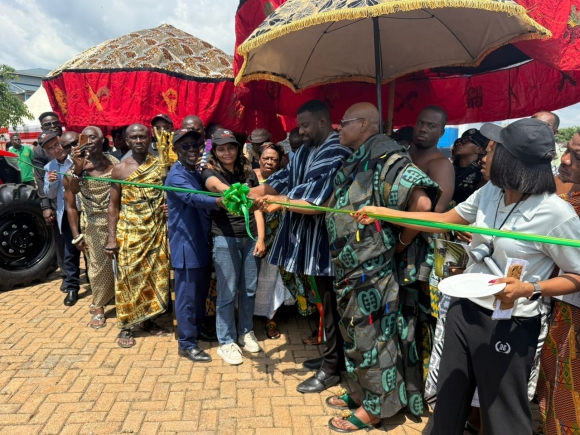
The Deputy Minister of Food and Agriculture, John Dumelo, has officially launched Captain Tractors onto the Ghanaian market and inaugurated a new Agricultural Mechanisation Centre in the Eastern Region, declaring that mechanisation is about empowering farmers, not replacing them.
Addressing farmers, traditional leaders and private sector partners at the ceremony, Mr Dumelo described the introduction of the tractors as a deliberate and strategic intervention to bridge the mechanisation gap for smallholder farmers.
“For too long, our smallholder farmers have been caught in the middle ground, needing more power than a hole. But finding massive industrial tractors impracticable or unaffordable,” he said.
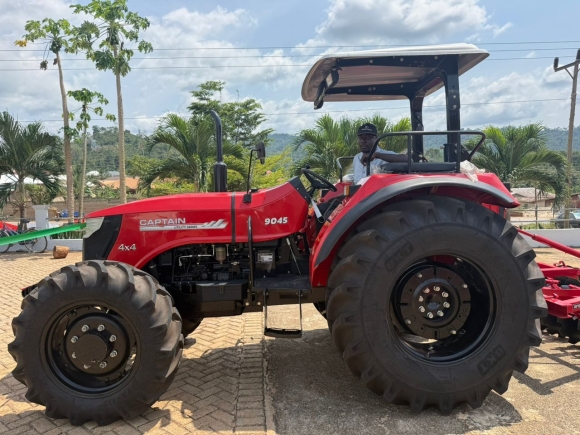
“These tractors represent precision and accessibility,” he added, explaining that their compact design would allow for easy movement across diverse terrains while delivering the horsepower required to transform farm operations.
He noted that the initiative would reduce farmers’ reliance on “back-breaking manual labor” enhance timely farm operations and ensure planting and harvesting happen “at the optical biological window”.
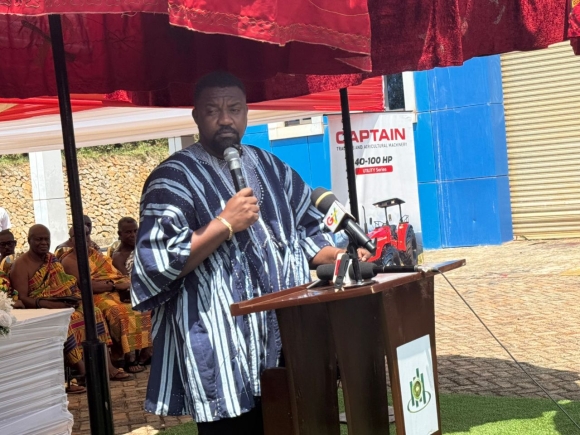
Describing the mechanisation centre as the most critical component of the initiative, he said: “A tractor without a service centre is merely a ticking clock. This centre will serve as a sanctuary for maintenance, a hub for spare parts, and, most importantly, a classroom.”
“We aren't just giving farmers keys. We are building an ecosystem of operators, technicians and entrepreneurs,” he stated.
Emphasising the policy direction, Mr Dumelo added, “Mechanisation is not about replacing the farmer. It is about empowering the farmer to do more and more and live better.”
Formally launching the tractors and inaugurating the centre, he said: “Together, let us plough the fields of hope and harvest the future of abundance. Thank you. God bless you. God bless Kweku, man and also, God bless Ghana.”
Mechanisation ‘the way to go’
Earlier, the Eastern Regional Director of Agriculture, Samuel Barima Offiso, described agricultural mechanisation as essential to improving productivity and incomes.
“For us, agricultural mechanisation is the way to go, because if we look at how to improve productivity, improve income and other things, we would have to change the way we do our culture,” he said.
He explained that the partnership between Hawkrad and Captain Tractors would provide mechanisation services not only to the enclave but to the entire Eastern Region and Ghana at large.
“Once this place begins to take off, one of the key services we'll be providing will be the mechanisation service that provides access to modern element tractors and their implements,” he said.
Mr Offiso added that the facility would also serve as a training and capacity-building centre for farmers and machine operators and hinted at future local assembly of tractors and implements.
“It is worth noting that a time is coming, and very soon, we'll be assembling some of the tractors and some of the implements at this same facility that we are gathered this morning,” he stated.
‘Africa lacks productivity per hectare’
A representative of Captain Tractors said Ghana stood at a decisive moment in its agricultural transformation, arguing that mechanisation was the key to unlocking productivity
She cited comparative data showing that while India cultivates most of its agricultural land with a tractor density of 35 to 45 tractors per 1,000 hectares, Africa averages only one to two tractors per 1,000 hectares. Ghana, he noted, records about one tractor per 1,000 hectares, with 5.8 million hectares of its 13.6 million hectares of agricultural land currently cultivated.
She stressed that the company was not merely selling tractors but offering end-to-end solutions across the crop cycle.
“We are not only there for a transaction, you know, we are there for a transformation,” he said. “Captain trackers stand here for Ghana's farmers, for Ghana's future.”
Custom hiring for smallholders
The Chief Executive Officer of Hawkrad Agric and Mechanisation Services, Nana Antwi Darkwah, said mechanisation should be seen as a public service system rather than simply the provision of machines.
He stressed that smallholder farmers do not necessarily need to own machinery but require reliable and affordable services.
“Most of these farmers do not necessarily need to own agricultural machinery. What they need are reliable, timely and affordable mechanisation services,” he said.
He explained that the custom hiring model being introduced would make machinery accessible without imposing heavy capital costs on farmers.
“Strengthening agriculturalization service is not simply a productive measure. It is not a showcase of machinery. It is rather a strategic investment in food security, economic resilience and national stability,” he added.
Traditional leaders back initiative
The Kwahuhene, Daasebre Akuamoah Boateng III, expressed gratitude to Nana Antwi Darkwah for establishing the facility in the area and urged farmers to form cooperative unions, assuring that Kwahu people are truthful and would repay loans as good businessmen.
He also raised concerns about the activities of herdsmen and called for ranching instead of free-range grazing, which he said destroys food crops.
The Kwahu Obomenghene, Nana Effah Opinamang III, also expressed gratitude to the partners for setting up the facility and expressed hope that it would boost productivity in the region.
He noted that about 80 per cent of the population in the area are farmers, from small-scale to large-scale operators, and said they could contribute to making Ghana food sufficient with financial support from the government.
He pledged to support and promote the operations to ensure that the facility does not become a white elephant, stressing that agriculture remains the backbone and future of government.