
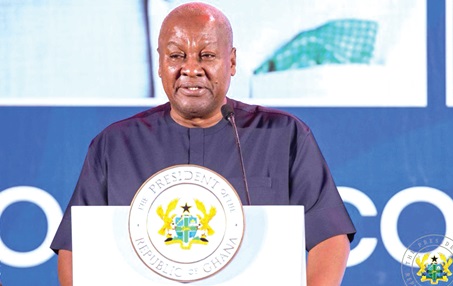
Reset mining sector with local content - President unveils 5 pillars to transform industry
President John Dramani Mahama has called for a fundamental shift in Ghana's mining sector, stressing that after more than a century of mineral extraction, the country must move from being merely a "prolific producer" to a "full participant" in the extractive value chain.
Delivering the keynote address at the maiden Mining Local Content Summit in Takoradi yesterday, President Mahama unveiled five strategic pillars that would guide the government's approach to transforming the sector, emphasising that local content must evolve from "transactional procurements to transformational partnerships."
"While Ghana is Africa's leading gold producer, and among the top six globally, much of the high-value activity in our mining value chain — advanced engineering, processing, equipment manufacturing, technical services and refining — still takes place outside our borders," the President said.
He disclosed that in 2023 alone, the extractive sector generated almost $6.6 billion in export revenues, yet local participation in high-value segments remained very limited, with domestic procurement accounting for only a fraction of total sectoral spend.
The two-day summit has brought together captains of industry, traditional leaders, policymakers, and international partners to deliberate on pathways for deepening local participation in Ghana's mining sector.
Five pillars
President Mahama stated that the first pillar would ensure that Ghanaian enterprises moved up the mining value chain "from suppliers of consumables to manufacturers of critical components, from service providers to innovators."
The second pillar targets the elimination of raw ore exports within the next five years, with the government supporting the establishment of refineries and bullion infrastructure.
"We must promote mineral-based industrial clusters. We must facilitate downstream processing of our bauxite, manganese and lithium," the President stated.
On human capital development, President Mahama announced that institutions such as the University of Mines and Technology (UMaT) and technical universities would be strengthened, with priority given to skills in automation, robotics, drone technology, data analytics and renewable energy integration.
The fourth pillar envisions Ghana becoming a hub of artificial intelligence-assisted exploration, Internet of Things-enabled asset management, and blockchain-based supply chain transparency.
Here, President Mahama outlined plans to establish a national mining innovation and research hub to institutionalise knowledge sharing.
The fifth pillar focuses on indigenous participation, with the President referencing the development of the Black Volta Gold project by Engineers and Planners Limited, the first mining project of such scale being undertaken by a wholly-owned Ghanaian company.
When operational, the project is expected to produce about 170,000 ounces of gold annually over a mine life exceeding 15 years.
Call for partnership
President Mahama urged international investors to view Ghana as a partner in progress rather than merely a destination for extraction.
"Ghana offers stability, policy clarity, and long-term partnership.
In return, we expect genuine collaboration that embeds capacity within our economy," he said.
Drawing lessons from Botswana's diamond sector, Chile's copper industry, and Indonesia's nickel processing mandate, the President stressed that "smart, enforceable, and forward-looking local content policies do not deter investment — they create sustainable competitiveness."
"What will be the true legacy of Ghana's vast mineral wealth a hundred years from now?" the President asked.
"Will it be recorded only in export statistics and royalty payments, or will it be remembered as the foundation upon which we build world-class industries?"
He concluded that if the country got it right, “our greatest export will not be raw gold, raw bauxite, raw manganese ore or lithium. Our greatest export will be Ghanaian talent, Ghanaian technology, Ghanaian enterprise, and a resilient, competitive mining economy."
Gold leaves, poverty stays
Earlier, the Paramount Chief of Essikado, Nana Kobina Nketsiah V, who chaired the occasion, set the tone with a stark observation: "Gold leaves but the poverty stays, this is why we are here today to close that gap."
The Minister of Lands and Natural Resources, Emmanuel Armah-Kofi Buah, welcomed delegates to what he described as a "defining conversation" for the sector.
"Is it not strange that after more than 100 years, we are now here to talk about local content in the mining sector?" he quizzed.
Mr Buah stated that in spite of its contribution of about 43 per cent of total merchandise exports, the sector had "largely operated as an enclave, existed alongside our economy, but not yet fully within it."
The Lands and Natural Resources Minister issued a stern warning against the practice of "fronting", where foreign companies hide behind Ghanaian names to satisfy regulatory requirements.
"To my fellow Ghanaian brothers and sisters, do not sell your birthright for crumbs when you can own the bakery," he said.
Reforms underway
The Chief Executive Officer (CEO) of the Minerals Commission, Isaac Tandoh, outlined sweeping reforms undertaken in just over 12 months, including the revocation of over 300 small-scale licences that were fraudulently acquired, and the operationalisation of District Mining Committees to ensure community-level input in licensing.
"We have completed a comprehensive overhaul of the Minerals and Mining Act, Act 703, and the Minerals and Mining Policy 2014," Mr Tandoh said.
He revealed that development agreements were being phased out entirely due to past abuses.
The Commission has also introduced a medium-scale licensing category to fill the gap between small-scale and large-scale operations, and proposed a new royalty regime that captures more value for the state when gold prices are high.
