
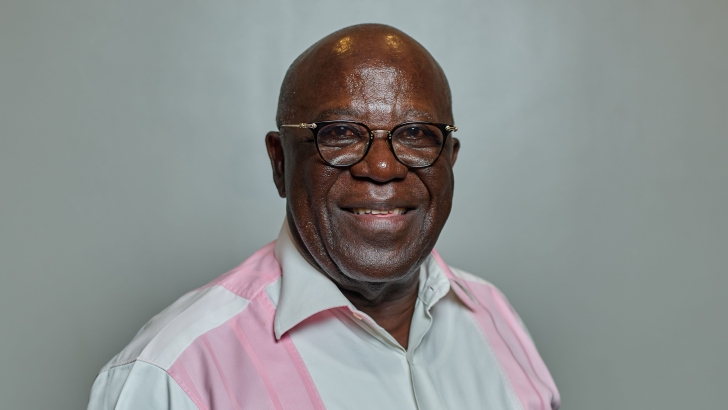
Ghanaian business leader Sir Samuel Esson Jonah has issued an open letter to Heads of State and Government of the African Union, calling for urgent continental unity and accelerated economic integration in response to what he describes as renewed imperial rhetoric from the West.
Sir Sam, Executive Chairman of Jonah Capital and former head of Ashanti Goldfields Corporation, addressed what he termed a “wake-up call” to African leaders following remarks attributed to United States Secretary of State Marco Rubio at the Munich Security Conference.
In the letter dated February 18, 2026, the renowned mining magnate said Rubio had spoken of the “terminal decline” of Western empires, blaming it on “godless communist revolutions and anti-colonial uprisings” that dismantled colonial rule after the Second World War. He said the US official called for revitalising “the greatest civilization in human history” and urged Europe to shed “guilt and shame” over its colonial past in order to reclaim a dominant “place in the world”.
Sir Sam wrote that critics had interpreted the speech as nostalgia for imperial dominance. “Make no mistake: these are not idle musings. They are a stark reminder that in the eyes of some global powers, Africa’s independence is a historical inconvenience, and our resources remain ripe for extraction,” he stated.
Framing his appeal as both a warning and an opportunity, he invoked a remark attributed to Canadian Prime Minister Mark Carney: “If we are not at the table, we are on the menu.” He argued that Africa has historically been “the feast for others—our minerals fueling foreign industries, our markets flooded with imports that stifle local growth, and our development tethered to the ‘generosity’ of donors whose aid often comes laced with conditions that serve their agendas, not ours.”
According to Sir Sam, the persistence of economic dependency, mounting debt and geopolitical manoeuvring demonstrates that “the end of formal colonialism did not end the exploitation”. He warned that neocolonial pressures remain embedded in global economic structures and that Africa must respond with what he described as “unashamed selfishness” in pursuit of its own interests.
The letter situates the appeal against a backdrop of deepening instability across the continent. Sir Sam pointed to insurgencies in the Sahel, wars in Sudan and the Horn of Africa, and insecurity in the Great Lakes region. He linked these conflicts to governance weaknesses, state fragmentation and external interference, while also highlighting rising debt burdens and climate shocks as compounding threats.
He described the convergence of armed conflict, economic strain, democratic erosion and shifting geopolitical alliances as “interconnected webs that demand a united response”, adding: “Divided, we are vulnerable. United, we become formidable.”
Central to his proposal is the acceleration of the African Continental Free Trade Area, which he described as the cornerstone of genuine sovereignty. While noting that 49 of 54 signatory states have ratified the agreement and that intra-African trade could rise significantly with faster implementation, he expressed concern that trade within the continent remains comparatively low.
Without the full ratification of complementary protocols, particularly on the free movement of persons, Sir Sam warned that the trade pact risks remaining aspirational. He argued that freer movement of entrepreneurs, skilled workers and innovators is essential to unlocking Africa’s economic potential.
Beyond trade, the letter calls for a decisive shift from donor dependence towards internally financed development, prudent debt management and greater value addition to Africa’s natural resources. It also urges strengthened cooperation under the African Union’s peace and security mechanisms to confront insurgencies and cross-border instability.
Addressing governance concerns, Sir Sam encouraged leaders to see youth-led protests not as threats but as demands for accountability. He called for stronger institutions capable of tackling corruption and democratic backsliding to ensure that young Africans can envision a viable future on the continent.
On foreign policy, he advocated a unified continental voice in global forums such as the G20, urging leaders to “Reject neocolonial overtures and negotiate partnerships on our terms, prioritizing African interests in global forums like the G20.”
In a direct appeal to African heads of state, he wrote: “Esteemed leaders, Africa is not a footnote in history; we are its authors.” Referencing the pan-African visions of Kwame Nkrumah, Kenneth Kaunda and Thomas Sankara, he argued that the present moment demands renewed commitment to continental solidarity.
“Rubio’s words are a provocation, but they can be our catalyst,” Sir Sam stated. “Wake up, unite, and act—before we find ourselves on the menu once more.”
