
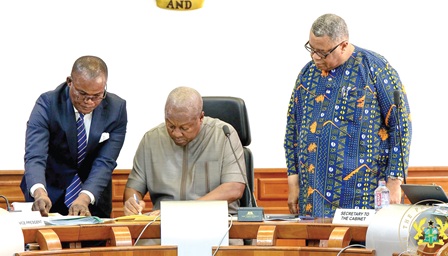
President John Dramani Mahama yesterday assented to the 24-Hour Economy Authority Bill, paving the way for the implementation of a policy his administration describes as a cornerstone of economic transformation.
The signing ceremony, which took place at the President's office at the Jubilee House just before the 13th Cabinet session, formalises the legal framework for an initiative designed to extend industrial and commercial activity beyond the traditional working hours.
In brief remarks after appending his signature, President Mahama acknowledged the high public expectations surrounding the legislation, stating that it was a key campaign promise that had required careful legislative handling.
"This is a law Ghanaians have been waiting for; it is one of our flagship strategies for economic transformation," the President said.
He explained that it had taken a while to come through, but “we needed to go patiently through the process to give legal effect to it, and so from now we must move from strategy to implementation."
Next phase
President Mahama said the business community was now looking to the next phase of the policy's rollout.
He added that both domestic and international investors were awaiting the specific incentive packages that would accompany the new legal regime.
"The business sector is waiting, Ghanaian investors are waiting, foreign investors are waiting," President Mahama said.
"They want to see the package of incentives that we can afford, so that they can invest more and expand productivity and also create more employment for our young people," he explained.
President Mahama commended the team that worked on the policy framework, making special mention of Goosie Tanoh and his task force for their contributions.
"Thank you, and let me congratulate the team that has been working on it, our comrade Goosie Tanoh, and his team.
We're very grateful.
Thank you very much," he added.
The 24-Hour Economy Authority is expected to oversee the implementation of a multi-shift work system aimed at maximising the use of industrial capacity and creating sustainable employment opportunities, particularly for the country's youth.
Parliament passed the 24-Hour Economy Authority Bill, 2025, on Friday, February 6, this year, to establish the 24-Hour Economy Authority in a bid to spur Ghana’s economic transformation.
Now a law, it provides the regulatory regime and the legal mandate for the formalisation and implementation of the 24-hour Economy policy.
The authority is to implement the 24-Hour Economy and Accelerated Export Development Programme of the government, a national economic transformation strategy aimed at enhancing productivity and promoting inclusive growth.
It will lead and coordinate the myriad policies, strategies, programmes and activities that will be implemented to transform the country into an economy that is working 24 hours.
Curbing raw material exports
The law also seeks to address long-standing structural issues within the productive economy of the country.
It will further seek to reduce the dependence of the country on exporting relatively low-value raw materials and reliance on costly imported finished and intermediate goods.
This is expected to end more commodity value, leaving the economy with each productive cycle, ultimately contributing to ending a cyclical crisis that hampered national development.
The passage of the bill into law enjoyed bipartisan support from both sides of the House after it was laid in the House by the Deputy Attorney-General and Minister of Justice, Dr Justice Srem-Sai, on December 3, 2025, and referred to the Committee on Constitution and Legal Affairs for consideration.
Programme in detail
On Wednesday, July 2, last year, President Mahama launched the government’s flagship 24-Hour Economy and Accelerated Export Development Programme, describing it as a “national reset” and a bold strategy to revive Ghana’s economy through round-the-clock productivity and expanded export capacity.
The initiative is backed by a projected $4 billion investment, with the government committing between $300 million and $400 million as seed capital to catalyse private sector participation.
The public funding, the President said, would be “catalytic” rather than dominant, focused on enabling bulk infrastructure and strategic rollout mechanisms.
He said the initiative represented a comprehensive shift in national policy direction, moving beyond political rhetoric to a coherent, multi-sectoral economic transformation agenda.
“This is more than a policy initiative; it is a national reset, a bold strategic shift to unlock our country’s full productive potential,” he stated.
“Today, we reclaim our founder’s vision of a self-reliant, industrious and inclusive African nation that works with its creativity and ensures prosperity for all,” President Mahama said during the launch last year.
He said the programme was designed not just to extend working hours, but to stimulate productivity, accelerate exports, and generate inclusive economic opportunities across key sectors, including agriculture, pharmaceuticals, manufacturing, logistics, infrastructure and textiles.
“Any government funding in 24-Hour Plus will be catalytic, serving as seed funding for the 24-Hour Plus Authority and supporting bulk infrastructure,” he explained.
Mahama stressed that the programme would be private-sector-led, with government playing a facilitative role to foster enterprise-level innovation and investment.
Financing for businesses under the programme will be sourced through commercial banks, development finance institutions (DFIs), and blended finance instruments to ensure sustainability and investor confidence.
At its core, the initiative aims to create 1.7 million quality jobs over four years, reduce import dependency, and reposition Ghana as a competitive player in regional and global export markets.
