
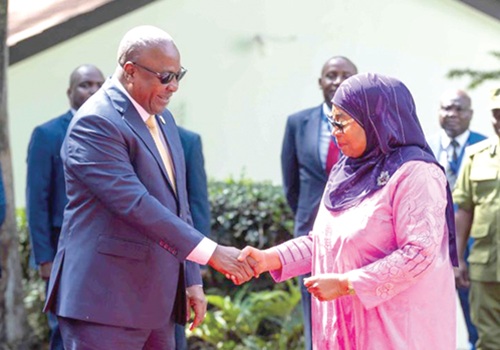
President John Dramani Mahama has said that the escalating military confrontations in the Middle East could lead to severe economic shocks across the African continent.
"We are watching the geopolitical events with alarm.
A few days ago, we witnessed attacks on Iran by the US and Israel, and counterattacks by Iran on Gulf countries, creating a new geopolitical situation.
"We know these shocks will come. But when they come, we must prepare ourselves to make sure our people are protected, because as it stands, that region is the epicentre of global oil supplies.
“And we know when crude prices rise above a certain level, it has a negative effect on our countries," he added.
The President, therefore, urged African nations to brace themselves for any impact, given the Middle East's status as the epicentre of global oil supplies.
Event
President Mahama was speaking at the State House in Arusha yesterday during bilateral talks with the Tanzanian President, Samia Suluhu Hassan.
President Mahama is in Arusha as the special guest of honour for the official opening of the 2026 Legal Year and the 20th anniversary celebration of the African Court on Human and Peoples' Rights.
He encouraged Africans to be proud of the court, and entreated countries that were yet to ratify the court’s protocol to do so.
On the economic partnership between the two countries, President Mahama observed that "we don't have a permanent Joint Commission for Cooperation between us. It's an issue we want to deal with as quickly as possible before a possible state visit we are negotiating."
Sovereignty
President Mahama further said that Ghana had developed an aggressive approach to asserting sovereignty over its natural resources, particularly gold.
"For the small-scale mining sector, we increased gold exports within nine months of the new regulation from 63 tonnes to 104 tonnes. That has been a significant inflow of some $10 billion in nine months," he said.
The President, therefore, urged African nations to control their resources to create opportunities for their youthful populations.
For agriculture, he outlined Ghana's plan to break free from external financing models that collateralised the country's cocoa beans to foreign lenders.
"From next season, at least 400,000 tonnes of our almost 700,000-tonne cocoa crop will be processed locally so we can add value before exporting," the President added.
And as the AU Champion on Reparations, President Mahama provided an update on the continent's push for reparative justice, confirming that a resolution to have the Transatlantic Slave Trade recognised as a grievous crime against humanity would be tabled at the UN General Assembly on March 25, 2026.
Shared lineage
President Hassan eulogised the shared lineage between the two nations, evoking the memory of Ghana's Kwame Nkrumah and Tanzania's Mwalimu Julius Nyerere.
"Ghana and Tanzania have shared historic relations.
Our first President, Nyerere, and Nkrumah were very close friends.
“So we have a joint history that has metamorphosed into shared values, and it makes it easy for us to build an even closer relationship together," she said.
President Hassan described Arusha not only as a tourist destination, but as a continental capital of justice and diplomacy.
The city is host to the East African Community Headquarters, the Pan-African Postal Union, the African Union Advisory Board on Corruption, and the African Court.
Focusing on the economy, President Hassan outlined Tanzania's economic trajectory, indicating six per cent growth, with inflation between 3.5 and four per cent.
She said her government's focus was on economic transformation through value addition, human capital development for a population where 60 per cent are youth, and climate resilience.
