
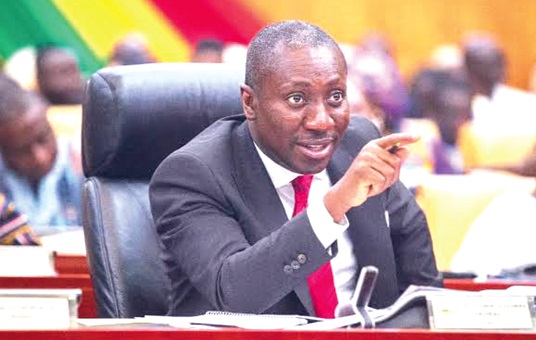
The Minority Leader, Alexander Afenyo-Markin, has urged Ghanaians and political leaders to commemorate the 20th anniversary of the passing of the First Speaker of Parliament, Justice D. F. Annan, by recommitting themselves to preserving the democratic values he defended.
He said Justice Annan's legacy demonstrated the importance of having institutions and individuals exhibiting impartiality over party loyalty in order to foster a collective sense of nation-building.
He explained that the former Speaker showed that any time an institution of state failed to rise above the partisan colours of those who headed it, contrary to the norm in Ghana’s politics today, “we perform below his noble standard”.
“Justice Annan did not lead a government department; he led a Parliament that belonged to every Ghanaian, on every side,” he said.
Standard measures
In a statement he read on the floor of Parliament to mark the 20th anniversary of the passing of Justice Annan last Thursday, Mr Afenyo-Markin said: “That is the measure he set, and it is the measure by which history will judge whether we were worthy successors, or merely occupants, of the offices he once dignified,” he said.
The Minority Leader said Justice Annan’s even-handed rulings, regardless of which caucus raised a matter, were the antidote to Speakers and officials reduced to instruments of Executive control.
“That affliction is now partly driving democratic backsliding across our sub-region,” he said.
On accountability beyond the chamber of Parliament, he said Justice Annan showed a willingness to face citizens directly at “Parliament in Retrospect” models, saying that was a standard that demanded “our fidelity today”.
“We must ensure that answerability to the people is never displaced by money, and that access to power is always earned through service, never purchased,” he said.
The Minority Leader pointed out that Justice Annan’s acceptance that even Parliament’s decisions might be tested by the Supreme Court affirmed a simple truth that no institution, however powerful or well-financed, stood above the law.
In his view, across parts of Africa, coups were becoming more fashionable as political finance threatened to eclipse public trust.
“Ghana owes Justice Annan’s memory nothing less than the deliberate practice of the enduring standards he quietly but elegantly modelled.
“I dare say that in more ways than one, he was the standard,” he said.
Reflections
The Minority Leader said 25 years after his passing, Justice Annan remained one of the principal architects of Ghana's Fourth Republic.
He said as the first Speaker of Parliament under the 1992 Constitution, Justice Annan did more than preside over a new legislature.
He said he helped to shape its culture, define its constitutional role and establish traditions that had enabled Ghana’s democratic experiment to endure.
At a time when constitutional democracies faced growing strain, Mr Afenyo-Markin said Justice Annan's life offered enduring lessons in leadership, restraint and fidelity to public service.
He pointed out that a former US President, Theodore Roosevelt, once observed that history belonged not to the critic, but to the person who pursued a worthy cause.
“Justice Annan belonged to that tradition as he accepted the difficult responsibility of leading a Parliament whose future was uncertain, and he did so with quiet confidence, intellectual discipline and unwavering respect for the Constitution,” he said.
Temperament, nation builder
Mr Afenyo-Markin indicated that when Ghana inaugurated the Fourth Republic in January 1993, success was far from guaranteed as the country was emerging from more than a decade of military rule.
Many questioned whether democratic governance would survive beyond a single electoral cycle, he said.
“Justice Annan entered that moment with the experience of a distinguished jurist and the temperament of a nation builder,” he said.
He said having retired from the Bench, the then Speaker answered the call to return to public service and became the first Speaker of Parliament under the new constitutional order.
Answerable to the people
Recounting how military coups had led to the dissolution of various national assemblies under three different Republics from February 1966 through to 1981, Mr Afenyo-Markin said: “Justice Annan broke that pattern”.
“Under his stewardship, and that of those who followed him, the Fourth Republic has since sustained nine Parliaments, and counting.
“As Speaker, Justice Annan did not just preside; he taught the House what it meant to be a Parliament,” he said.
He recalled how, in a lecture on the powers, privileges and immunities of Parliament, Justice Annan explained that Parliament might be called “a master of its own procedures”.
