
Producer responsibility bill for plastics in the offing
The Ministry of Environment, Science and Technology (MEST) has drafted a bill that seeks to place financial responsibility on plastic producers to contribute to recycling plastic waste.
Known as the Extended Producer Responsibility (EPR) scheme, the bill, when passed into law, will ensure the sound management of plastics by making it mandatory for producers to pay for what they produce.
The Director of Environment at MEST, Peter Dery, made this known to the Daily Graphic, explaining that the initiative was part of a comprehensive policy for the efficient regulation and management of plastics in the country.
"We have the draft bill ready and are discussing it with the attorney general. Once it is finalised, it will go through the necessary legal processes and be rolled out somewhere next year," he said.
Nestle Ghana donation
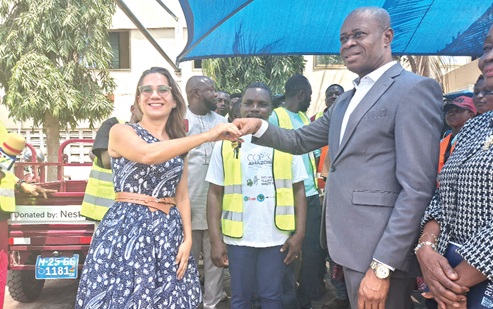
He spoke to the Daily Graphic when the Deputy Minister of Lands and Natural Resources, Alhaji Yusif Sulemana, handed over 10 tricycles and other Personal Protection Equipment (PPE) to the ministry to support plastic waste collection.
The tricycles and PPEs were donated by Nestlé Ghana Limited, a private entity.
The Managing Director of Nestlé Ghana, Salome Azevedo, presented the keys to the tricycles to the deputy minister, who handed them over to the chairman of the Plastic Collectors Association.
Context
According to the UNDP, more than 400 million tonnes of plastic is produced worldwide, yet only 10 per cent of it is recycled.
The rest is either burned, buried or left to pollute the natural environment.
The consequence is that about 11 million tonnes of plastic waste leak into the oceans yearly.
For Ghana, the UNDP estimates that 840,000 tonnes of plastic waste are generated annually, while only 9.5 per cent is collected for recycling.
The rest ends up in landfills, open dumps or the environment, exacerbating city flooding, harming wildlife and posing health risks to communities.
Interventions
Mr Dery said apart from the EPR, which was being developed, MEST was currently implementing some interventions aimed at recycling plastics. For instance, he said, the circular economy action plan had been drafted for implementation.
Again, the ministry was supporting some small and medium-scale enterprises (SMEs) with small grants to upscale plastic recycling under the Global Environment Facility (GEF).
He said under the GEF programme, which came through the United Nations Industrial Development Organisation (UNIDO) and the United Nations Development Programme (UNDP), about $7 million was being disbursed to SMEs.
"The disbursement started in March this year, with 10 SMEs already benefitting from it. Some got $250,000 and others got more than that," he added.
Mr Dery said MEST was also working with the private sector, including Nestlé Ghana, to mobilise more resources to support informal waste pickers.
Collective responsibility
For his part, Alhaji Sulemana commended Nestle Ghana for providing tricycles and other logistics to support the management of plastics.
He stressed that while the government had the ultimate responsibility to roll out policies to stop plastic pollution, all stakeholders must play a role in tackling the menace holistically.
“The media houses need to use their platforms to create awareness; private companies must promote sustainability by providing resources for sound plastic management and all of us must act responsibly by not throwing plastic around anyhow,” he said.
Ms Azevedo said Nestle Ghana was an environmentally conscious organisation, which was why the company had prioritised the provision of the tricycles and other PPEs to plastic waste collectors.
“Since 2019, Nestlé Ghana has been making a conscious effort to collect plastics. To date, we have donated 78 tricycles to support plastic collection, and we are adding 10 more today together with PPEs in our commitment to keep the environment clean and safe,” she said.
