
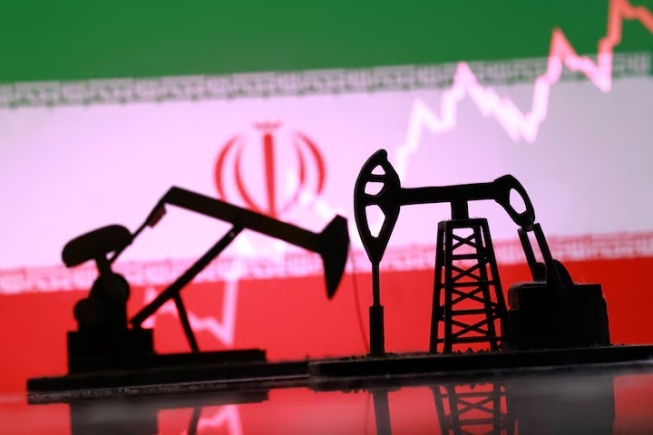
Oil prices jumped more than 3% on Thursday, extending a rally as the escalating U.S.-Israeli war with Iran disrupted supplies and shipping, driving some major producers in the Middle East to reduce output.
Brent crude was up $2.92, or 3.59%, at $84.32 per barrel by 11:43 a.m. EST (1643GMT), a fifth session of gains. U.S. West Texas Intermediate crude rose $4.40, or 5.89%, to $79.06.
U.S. crude futures rose more than 7% during the session to reach their highest since January 2025.
Donald Trump told Axios on Thursday that he needs to be personally involved in selecting Iran's next leader.
"Khamenei's son is unacceptable to me. We want someone that will bring harmony and peace to Iran," Axios quoted Trump as saying in an interview.
"I have to be involved in the appointment, like with Delcy in Venezuela," Trump said.
Missile attacks hit eastern Tehran, Iran's ISNA news agency reported, and sirens rang in Dubai as war continued to spill over across the region.
Crude oil supplies from Iraq and Kuwait could start shutting within days if the Strait of Hormuz remains closed, potentially cutting 3.3 million barrels per day by day eight of the conflict, JPMorgan analysts said in a note.
Around a fifth of global oil flows through the Strait.
"Crude prices are going to be very sensitive to the Strait’s closure as eventually production in the exporting areas will slow and if this persists into next week, the eventual re-starting of production and re-vamping of shipping once the Strait is re-opened will also take time to get back online," said Dennis Kissler, senior vice president of trading at BOK Financial.
Iraq, the second-largest crude producer in the Organization of the Petroleum Exporting Countries, has cut output by nearly 1.5 million bpd for lack of storage and an export route, officials told Reuters.
Qatar, the biggest liquefied natural gas producer in the Gulf, declared force majeure on gas exports on Wednesday, with sources saying a return to normal production volumes may take at least a month.
CONTINUED ATTACKS ON OIL TANKERS
Attacks on oil tankers continued on Thursday in the Gulf, as the Bahamas-flagged crude oil tanker Sonangol Namibe reported its hull was breached after a blast near Iraq's port of Khor al Zubair.
Those attacks, along with Chinese measures to reduce fuel exports, pushed prices higher, said UBS analyst Giovanni Staunovo. The refined product market is also showing signs of stress due to missing Middle East exports, he added.
Some oil refineries in the Middle East, China and India shut their crude units because of the raging conflict in the Middle East.
As a result of a lower supply outlook in fuel markets, U.S. diesel futures were trading at their highest level since January 2023, at around $3.54 a gallon.
Around 300 oil tankers remained inside the Strait of Hormuz after vessel traffic in and out of the chokepoint nearly halted following the outbreak of war, according to ship tracking data from Vortexa and Kpler that excludes some of the smallest tankers.
Iran launched a wave of missiles at Israel early on Thursday, sending millions of residents into bomb shelters as the conflict entered its sixth day, and just hours after moves to halt the U.S. attacks were blocked in Washington.
On Wednesday, a U.S. submarine sank an Iranian warship off Sri Lanka, killing at least 80 people, and NATO air defences destroyed an Iranian ballistic missile fired towards Turkey.
