
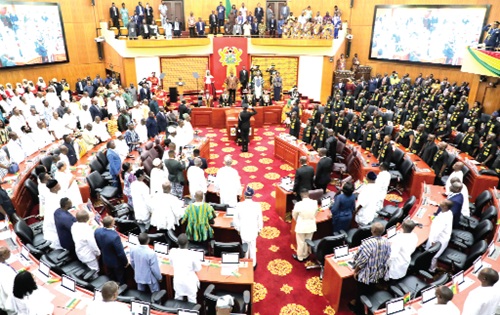
President John Dramani Mahama has declared that no patient must be turned away from any health facility they report to, no matter the circumstance.
“Patients facing medical emergencies must be received and given help, even if under makeshift conditions.
"You don't need to have a comfortable bed to save a patient. No patient must be turned away from any health facility they report to," President John Dramani Mahama stressed.
Delivering his second message to Parliament yesterday on the State of the Nation, the President said the Ministry of Health was in line to issue guidelines on the unacceptable “No Bed syndrome”.
He said healthcare professionals must prioritise immediate care and saving lives above all else, saying that the core purpose of healthcare must transcend amenities and focus on the well-being of every citizen.
In the meantime, he said the government would implement measures to expand the bed capacity at hospitals in the Greater Accra and Ashanti regions.
The measures include implementing the Ridge Hospital Phase Two project to increase the number of beds at the Greater Accra Regional Hospital.
The government would also continue projects at the Police and the La General Hospitals.
Also, the Sewua, Afari Military Hospital and the Maternity and Children’s Block at the Komfo Anokye Teaching Hospital, all in the Ashanti Region, would be pursued.
The ultimate goal, President Mahama said, was to "build a stronger, more resilient and more self-reliant health system for all Ghanaians."
Context
The President's declaration follows the unfortunate death of a 29-year-old Engineer, Charles Henry Amissah, a victim of a hit-and-run incident at the Kwame Nkrumah Circle Overpass in Accra, who was laid to rest yesterday.
He was refused emergency care by three major hospitals in Accra, with the explanation of "no vacant bed available," until he died.
President Mahama stressed the government's commitment to building a resilient health system where timely and compassionate care was paramount, making it clear that accessibility and patient-first treatment were non-negotiable.
Health sector
Delivering what is popularly known as the State of the Nation Address (SONA), President Mahama said the government in January 2025 inherited a health system under severe strain, characterised by ageing and deteriorating equipment and stalled hospital projects, amounting to GH¢15 billion in liabilities.
He said growing workforce pressures at the time had also weakened service delivery.
Over the past year, the President recalled, donor support for the health sector has also declined from 19 per cent to 2.2 per cent currently, creating an annual financing gap of more than GH¢2.4 billion.
The President said the government acted decisively, increasing direct government funding of the sector to about 72 per cent of total health spending, up from 56.8 per cent in 2023, bringing the total government funding of the health sector to GH¢34.7 billion.
Touching on some of the measures introduced over the past year, the President mentioned the MahamaCares, which would take care of the growing burden of non-communicable disease (NCD), which accounted for 40 per cent of all deaths and remained a major source of poverty.
He said the National Health Insurance Fund had been uncapped, which had paved the way for timely payments to facilities.
Health workforce density, he said, had increased from 16.6 per cent for every 10,000 people in 2025 to nearly 42 per cent, while public sector health workers had doubled to nearly 200,000.
The President, however, pointed to significant challenges that remained.
He said at the beginning of 2025, 103,000 trained health workers were still not enrolled to work; however, over the past year, 13,000 nurses and midwives, along with hundreds of doctors, had been absorbed onto the public payroll.
President Mahama said going forward, the government would expand recruitment and take necessary actions to add more health workers to the payroll.
The government would also improve the distribution of health workers with the implementation of incentives.
The President, however, called on health workers to accept postings to deprived areas as a national call to duty, as the state worked to further improve their working conditions in those areas.
Roads
Shifting focus to infrastructure, President Mahama detailed a massive undertaking to revitalise the country's road network, dubbed the "Big Push Infrastructure Programme," which aims for a "natural infrastructure drive to restore critical national infrastructure."
The ambitious road programme, the President said, had already seen work commence on 50 major projects spanning 1,144 kilometres, with an estimated cost of GH¢50 billion.
"Furthermore, the government is completing 23 projects awarded by the previous administration but left unpaid, covering an additional 573 kilometres at an estimated cost of GH¢15 billion. Combined, this means "about 2,000 kilometres of roads are currently undergoing rehabilitation as I speak," President
Mahama said, adding that " this is the biggest major investment in our road sector in the history of Ghana."
He stated that across all 16 regions, 73 projects were advancing, with significant visible progress expected by the end of the year.
The President acknowledged the significant financial burden inherited in the road sector, with "standing payments on road projects financed through the Consolidated Fund at GH¢21 billion Ghana Cedis" as of December 2024, representing certified works that had not been paid.
Additionally, the President said indebtedness to contractors lodged with the Ghana Road Fund Secretary amounted to GH¢5.43 billion, excluding accruing interest charges of GH¢7.8 billion. Contractual commitments, or signed contracts, totalled over GH¢104 billion.
Despite these challenges, the President reported progress: "By the end of 2025, the Ministry of Finance and Roads had cleared arrears amounting to almost GH¢10 billion owed to road contractors," and the government is "steadily continuing to reduce the road sector debts."
Coders programme
On the One Million Coders programme, President Mahama said it took off in March 2025 as part of the government's agenda to ensure that young Ghanaians acquired essential digital skills for the modern global economy.
He said the initiative was aimed at training one million Ghanaians in key data areas, including data analytics, data protection, cyber security, and meta-analytical intelligence over four years.
The President said the first phase of the programme, the pilot phase, had seen hundreds of trainees complete their programmes in-person across four training centres in Accra, Kumasi, Sunyani and Bolgatanga.
He said the phase two, which would include virtual sessions, was set to commence this year.
"With expanded training centres and an increased number of beneficiaries, we project that 400,000 young Ghanaians will be trained this year, and this will build up to the numbers approaching one million," the President said.
