
GIFF calls for risk-based transit measures after Tema tax evasion incident
The Ghana Institute of Freight Forwarders (GIFF) has urged the government to reassess recent transit policies following a joint enforcement operation by Ghana Revenue Authority (GRA) Customs officials and the National Security.
The operation led to the interception of 12 articulated trucks carrying large quantities of food items, representing a significant potential revenue loss to the state.
While stressing that it does not condone illegal activity, GIFF called for a balanced approach that protects revenue while maintaining Ghana’s position as the preferred transit hub for Sahel-bound cargo.
Electronic tracking confirms operational integrity
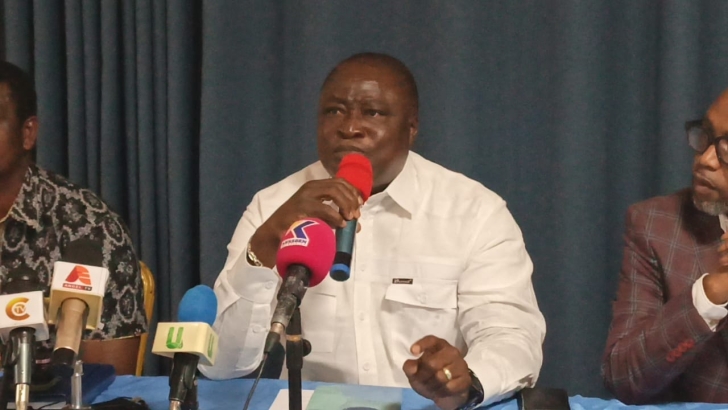
Speaking at a press conference on Wednesday, February 25, 2026, in Tema, GIFF General Secretary Paul Kobina Mensah said all 18 trucks involved were electronically tracked, with six trucks initially reported missing later physically verified.
He explained that “route deviations occurred after enforcement-related diversions to the Tema Transit Yard, outside the declared corridor, highlighting the system’s operational integrity.”
Following the incident, the government banned land transit of cooking oil through Ghana’s borders, mandating that all consignments be routed exclusively through seaports. The directive, issued by Finance Minister Dr Cassiel Ato Forson, aims to close loopholes that have exposed the state to revenue losses.
Broad restrictions could penalise compliant operators
GIFF warned that sweeping restrictions could unintentionally penalise compliant operators and introduce regulatory uncertainty. “Broad restrictions, if not carefully calibrated, may unintentionally penalise compliant operators and destabilise the transit regime,” Mr Mensah said.
He emphasised that traders have a right to optimise cost, time, and routing within legal frameworks, noting that corridor choice is often a rational response to port costs, dwell times, and procedural efficiency.
The Institute acknowledged areas for legitimate reform, including escort policy consistency, transit bond adequacy, route dwell monitoring, and post-clearance reconciliation. It stressed that these should be addressed through targeted, intelligence-driven measures rather than blanket commodity restrictions.
Strategic and diplomatic risks
GIFF cautioned that transit trade is highly sensitive to policy signals. Toughened restrictions could push Sahel-bound cargo to alternative routes, reduce utilisation of Ghana’s transit infrastructure, and lower Customs volumes.
“Cargo owners in Niger, Burkina Faso, and Mali maintain alternative options and respond quickly to perceived friction,” Mr Mensah said.
The Institute also highlighted potential diplomatic risks, noting that broad tightening of transit access could prompt neighbouring countries to impose mirror administrative barriers, recalibrating corridor preferences away from Ghana.
Mr Mensah said Ghana’s leadership in the AfCFTA era is best preserved through “firm but facilitative compliance enforcement.” He urged reforms to focus on risk-based escorts, incident reconciliation, stakeholder engagement, and clear guidance to distinguish genuine diversion from enforcement anomalies.
The President of GIFF, Stephen Adjokatcher, reaffirmed the Institute’s support for government revenue protection, emphasising that “enforcement and trade facilitation must work hand in hand to safeguard Ghana’s transit advantage.”
