
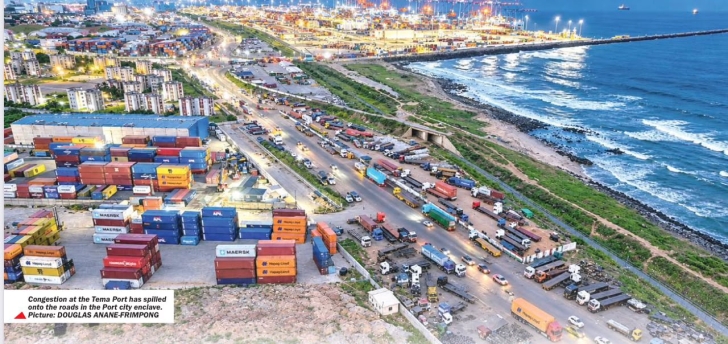
The business comunity has called for measures to address container congestion at the Port of Tema, as the impact spills onto the roads in the port city.
The congestion also has implications for road users and businesses. Businesses that depend on road transportation may experience additional operating costs when traffic delays affect cargo movement and delivery schedules.
Commercial drivers are also losing productive hours, while passengers take longer to reach their destinations.
There are also concerns about access for emergency services in and outside Tema.
Tema hosts major health facilities, including the International Maritime Hospital in Tema Community 3 and the Tema General Hospital in Community 9.
With traffic congestion occurring along the affected corridor, emergency vehicles now require additional time to move through and around busy areas.
Industry
The First Vice-President of the Ghana Institute of Freight Forwarders (GIFF), Nana Asiamah Peprah I, said the congestion was affecting businesses by increasing the time and cost involved in moving goods.
He stated that a journey that normally took 30 minutes could now take as long as two hours, creating a disadvantage for businesses that depended on the efficient movement of goods and people.
Nana Peprah explained that activities at the port were time-sensitive and that every delay added to the cost of doing business, with the additional costs eventually passed on to consumers.
“Every congestion, in fact, the normal congestion in the ports always affects businesses and those businesses will also pass it on to the consumers,” he said.

Let’s create space
Nana Peprah stated that the parking of trucks on the shoulders of roads was largely a consequence of limited capacity at some terminals to receive empty containers after cargo had been discharged.
He explained that some shipping lines had private container terminals that had become full, forcing trucks to queue at alternative facilities and, in some instances, extending the queues from the MPS terminal to Nungua Barrier.
He stressed that the situation had been raised at meetings with port and other relevant authorities, but practitioners were yet to see the proposed solutions implemented.
He said that authorities and shipping lines needed to identify additional spaces outside the Tema Port enclave where containers could be temporarily stored to reduce pressure on existing terminals and ease congestion.
Importers, exporters
The Executive Secretary of the Importers and Exporters Association of Ghana (IEAG), Samson Asaki Awingobit, said congestion was contributing to increased vehicular and trade-related traffic within the port enclave and adjoining areas.
He consequently urged the Ghana Ports and Harbours Authority (GPHA) to consider using some properties and spaces currently leased to private businesses for additional container terminal facilities, especially where lease agreements were approaching expiration.
Mr Awingobit said additional modern container terminal facilities could increase holding capacity, improve cargo-handling efficiency and support the movement of goods and vehicles.
GPHA measures
The concerns come against the backdrop of measures announced by the GPHA to address landside congestion.
In a statement issued on August 7, 2026, the authority acknowledged landside congestion at the Port of Tema, and attributed the situation partly to growth in import traffic, the evacuation of empty containers and road congestion.
The GPHA said it had placed relevant stakeholders on heightened operational alert, and was working with shipping lines and terminal operators to accelerate the evacuation of empty containers.
The measures include increased vessel calls, enhanced truck deployment and container-transfer operations, as well as improved yard and traffic management to maximise available terminal capacity.
The authority further appealed to importers, clearing agents and cargo owners to expedite the clearance and evacuation of their consignments, saying the prompt removal of cargo would create additional space within the port.
Currently, increased container truck movements extend beyond the port enclave, adding pressure to road space shared by heavy-duty vehicles, motorists, commercial vehicles, motorbikes and pedestrians.
The situation, particularly along the Nungua Beach Road corridor towards Sakumono and other adjoining routes, has resulted in longer travel times for motorists, while the movement and parking of heavy-duty trucks along sections of the road have added to the chaos.
Pressure is also being felt along routes towards Ashaiman, where increased movement of container trucks combined with regular vehicular traffic is placing additional pressure on the road network.
For residents, the issue goes beyond delays and inconvenience. They are concerned about the need for safe interaction between heavy-duty trucks and other road users, including private vehicles, commercial transport, motorbikes and pedestrians.
Motorists’ concerns
Motorists travelling on the Nungua Beach Road say traffic conditions have become more challenging, particularly during peak periods.
The road between Tema Community Three and Sakumono has become an important corridor for vehicles serving the port and surrounding communities.
Increased truck movements and general traffic have, however, added to travel difficulties in the area, while trailers and heavy-duty trucks parked on the shoulders of the highway have added to the inconvenience on the stretch.
For instance, the size of articulated trucks parked along the road creates blind spots, requiring drivers to take additional care around smaller vehicles, motorbikes and pedestrians.
The situation has thrown the spotlight on the limited designated parking facilities for long-distance trucks using the route.
Some drivers told the Daily Graphic that they had limited access to designated parking areas where they could safely keep their vehicles while waiting for cargo assignments.
One such driver acknowledged that parking on the shoulders of the highway was not permitted, but said the non-availability of suitable parking spaces remained a concern.
The driver, who sought anonymity, explained that some trucks were waiting for customers to assign them cargo to destinations in other countries within the sub-region.
Writer's email:
