
UCC professor develops device to detect unsafe food
Professor of Agri-food Integrity Engineering, Ernest Teye, and a team of researchers have developed an innovative food testing device that uses advanced sensing technology to detect unsafe food.
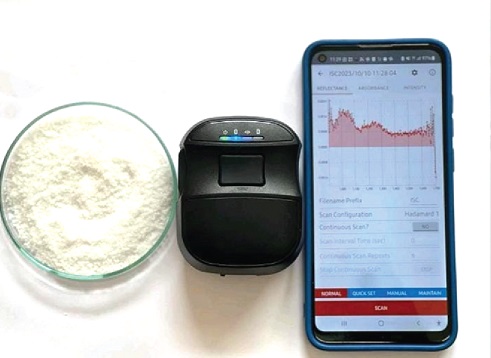
The device is able to analyse the chemical composition of food without destroying the sample, and is a breakthrough towards safeguarding consumption by the public.
The handheld device scans the food item using light-based sensors, often near-infrared spectroscopy, to detect hidden substances such as harmful chemicals, toxins or adulterants that may not be visible to the human eye.
When the device is placed close to a food product, it collects data from the sample and compares the results with information stored in its database to determine whether the food is safe or contaminated.
Prof. Teye, who is at the Department of Agricultural Engineering of the College of Agriculture and Natural Sciences of the University of Cape Coast (UCC), said within seconds, the device would provide feedback on a connected screen or mobile application, indicating the quality and safety status of the food.
This rapid detection method, he said, could assist regulators, farmers and consumers to identify unsafe food early to prevent potential health risks.
Delivering his inaugural lecture at UCC last Thursday, Prof. Teye called for the establishment of a national framework to safeguard food integrity and keep consumers safe.
He expressed concern that "food fraud" could be silently endangering lives, and urged stakeholders to treat food safety as a national priority, stressing the need for greater public awareness about food fraud.
Food fraud, the academic referred to the deliberate substitution, addition, tampering, or misrepresentation of food, food ingredients or food packaging for economic gain.
Prof. Teye stressed that food remained the one thing that united humanity and lay at the centre of national development, stressing that without safe and reliable food systems, sustainable development would remain unattainable.
The lecture, on the theme: “Agri-food — Hungry Man: Developing the Food Oracle in the Face of Insecurity and Climate Change”, brought together academics, students, researchers and industry players to reflect on the growing threats facing food systems and the innovative technologies being developed to address them.
Food safety, human survival
Prof. Teye explained that food safety went beyond agriculture and directly affected human health, economic growth and social stability, saying many deaths and illnesses could be linked to unsafe or adulterated food.
He explained that his research focused on developing artificial intelligence-driven technologies capable of identifying contaminated or poor-quality food within seconds, a breakthrough he described as a game changer for farmers, consumers and regulators.
“We already have the oracle within us through our senses but science has enhanced that oracle through technology to help us to detect unsafe food quickly and accurately,” he stated.
Unsafe agriculture inputs
Prof. Teye further stated that one of the major causes of low agricultural productivity in Africa was the widespread circulation of counterfeit fertiliser and poor-quality seeds, which prevented farmers from achieving expected yields.
He observed that despite Africa possessing about 60 per cent of the world’s arable land, the continent still produced far less food than other regions due to challenges linked to poor input quality and weak monitoring systems.
According to him, research conducted across several African countries uncovered alarming levels of fake fertiliser in circulation, a situation he said undermined farmers’ investments and threatened food security.
He emphasised that when farmers unknowingly used substandard inputs, the result was poor harvests, environmental damage and financial losses.
“Garbage in, garbage out. If the inputs are not right, the output will never be right,” he stressed.
Prof. Teye highlighted several technological innovations developed by his research team to improve food production and safety, including portable devices capable of analysing soil nutrients, detecting fake fertiliser and verifying seed quality within seconds.
He explained that those tools powered by artificial intelligence and mobile technology could be used directly on rural farms to significantly increase crop yields, reduce losses and strengthen Ghana’s ability to compete in the global food market.
Prof. Teye called for the creation of specialised institutions to monitor food quality and to enforce standards across the agricultural value chain.
He disclosed that plans were underway to establish an AfriFood Integrity Centre at the UCC to promote research, training and policy development in food safety and agricultural innovation, train farmers, develop rapid detection technologies and support government efforts to strengthen food regulation systems.
He called for collaboration among government agencies, universities, farmers and consumers towards food integrity, saying "food is not just what we eat; it is medicine, it is health, and it is life. If we protect the integrity of our food, we protect the future of our nation”.
Ghana’s food future
Prof. Teye expressed optimism that with the right policies, technology and commitment, Ghana could become a major food producer and exporter in the near future.
He encouraged young people and researchers to embrace innovation in agriculture and contribute to building a resilient food system capable of withstanding climate change and global food challenges.
The acting Vice-Chancellor of UCC, Prof. Denis Worlanyo Aheto, who chaired the event, indicated that inaugural lectures formed part of the university’s deliberate efforts to promote academic excellence and to showcase research that responded to pressing national development challenges.
He said the university remained committed to creating platforms that allowed scholars to share innovative findings that could contribute meaningfully to policy formulation, industrial growth and national progress.
