
The Vice-President, Prof. Naana Jane Opoku-Agyemang, has called for a renewed commitment to promote strong family values, advance social inclusion, protect vulnerable members of society and build resilient institutions capable of sustaining democratic governance, the rule of law and long-term national development.
She said the country's future could not be secured solely through policies, programmes or financial investments and that "sustainable national transformation requires a moral compass that guides leadership, strengthens institutions, promotes justice, and inspires every citizen to place their national interests above personal gain.”
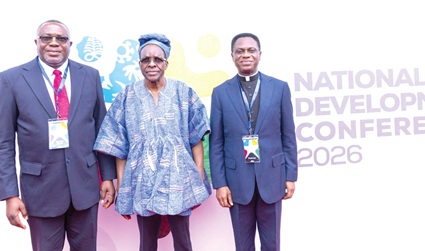
Prof. Opoku-Agyemang said this yesterday in an address read on her behalf by the Policy Advisor for Political Affairs of the Office of the Vice-President, Dr Samuel Ofosu-Ampofo, at the National Development Conference of the Church of Pentecost, ongoing at the Pentecost Convention Centre at Gomoa Fetteh in the Central Region.
Development
Prof. Opoku-Agyemang believed that development must always place people at the centre and that a nation's greatest asset was not merely its natural resources, but the values, discipline, creativity and integrity of its citizens.
That conviction, she said, resonated strongly with the theme of the event and aligned with the government’s vision of building a Ghana where honesty was rewarded, corruption rejected, public resources protected, institutions strengthened, and opportunities created for every Ghanaian regardless of background, ethnicity, religion, gender, or political affiliation.
"The government recognises that no nation succeeds when its institutions operate in isolation.
"The complex challenges confronting our country, including unemployment, environmental degradation, corruption, social inequality, declined public trust, and conflicts within some communities, require collective responsibility and shared leadership," she said.
Participants
The three-day conference is being attended by traditional rulers, religious leaders, members of the judiciary, security services, academia and government officials, among other personalities.
The event is a high-level national dialogue aimed at promoting ethical leadership, responsible citizenship and sustainable national development.
It is being held on the theme: "Moral Vision and National Development".
Leadership
Prof. Opoku-Agyemang emphasised that leadership was fundamentally about service, integrity, compassion, humility, accountability, and the empowerment of others.
She said recommendations emerging from the conference should not remain as a conference resolution alone.
Rather, they should help shape public policy, inspire institutional reforms, strengthen civic education, and encourage every Ghanaian to embrace integrity, active citizenship, and personal responsibility in the shared task of nation building.
"National development is not the responsibility of government alone, neither is it the sole responsibility of traditional authorities, religious institutions, civil society and the private sector.
It is a collective national obligation that calls for the contribution of every citizen, every institution and every community," she said.
Conscience of people
The Chief Justice, Paul Baffoe-Bonnie, said no nation could rise higher than the conscience of its people.
For many years, he said, "we have discussed how to develop Ghana, we have debated policies, budgets, roads, industries and investments".
All of those, he said, mattered, yet development was not only an economic project; it was first a moral project.
The problem before the nation, Mr Baffoe-Bonnie said, was not merely legal or technical; it was moral.
"As Chief Justice, I know the importance of the law, yet I also know its limits,” he said.
He said courts could determine rights, they could punish wrongdoing, uphold the constitution, but no court could compel honesty.
No IMF
The President of the Central Regional House of Chiefs, Odeefo Amoakwa Buadu VIII, cautioned the country against going to the International Monetary Fund for the 18th support.
He said it was evident that the advancement of the nation would not only be determined by economic progression or infrastructure, but the strength of its morals, collective values, principles and ethical standards to guide people's actions and decisions.
