
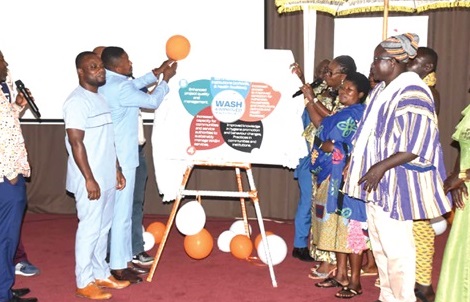
World Vision launches $1.5m WASH project in Sekyere Afram Plains District - Expected to benefit 25,492 individuals across 19 communities
$1,593,565.15 million project aimed at improving access to Water, Sanitation and Hygiene (WASH) facilities has been launched in the Sekyere Afram Plains District in the Ashanti Region.
The five-year project known as “Sekyere Afram Plains WASH 4 Health project” is being funded by a philanthropist through World Vision Canada to improve access to water and sanitation facilities in 19 communities.
Another project funded by the Groundfos Foundation, the Groundfos WASH 4, will improve child well-being in two schools within the same district for one year. Both projects are running concurrently.
Being implemented by World Vision Ghana, a Christian relief, development and advocacy organisation, the projects will use the ‘WASH in schools’ approach, pay-as-you-fetch and the NGO model to implement.
Both projects aim to directly benefit 25,492 individuals, four health facilities, and 19 basic schools within the district, thereby enhancing the protection of the most vulnerable children and their communities by providing sustainable access to WASH facilities by 2029.
Under the projects, 12 solar-powered mechanised water systems with reservoirs will be constructed, as well as seven handpump swaps for smaller communities, while 12 institutional latrines with changing rooms and menstrual hygiene facilities will be constructed for schools and health facilities.
Also, there will be the provision of 144 dustbins, 40 handwashing facilities, the construction of two four-seater disability-friendly institutional latrines, the construction of one water system, among others.
Transformation
A Programme Associate Director, WASH, World Vision Ghana, Robel L. Wamisho, said the projects were aimed at transforming communities by improving WASH services for the benefit of the people.
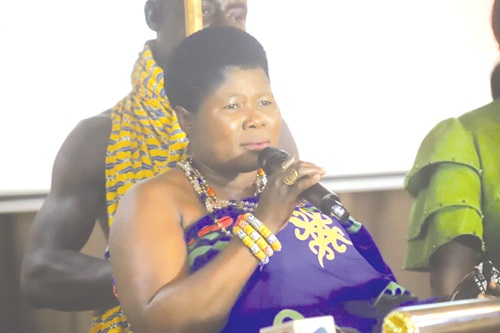
Nana Adu Akosua Fofie II, the Drobonsohemaa, speaking at the event
By doing so, he indicated that it would help reduce the impact of diseases, enable schoolchildren to attend school regularly and not skip school in search of water, and especially encourage adolescent girls to attend school during their menstrual period.
He mentioned that it was feasible for the Sekyere Afram Plains WASH 4 Health project to achieve its goals by the five-year period, emphasising, “we are doing it in collaboration with all key actors and partners to execute it successfully.”
Poorest district
The Regional Operations Manager, Southern Region, World Vision Ghana, Ivan Aboagye, said even though, per land mass, the district was the biggest in the region, it was also unfortunately the poorest.
He said, looking at the district’s data in terms of WASH facilities, they were the most vulnerable in the region, adding, “This is why World Vision strategically chose the district to work there.
“This project is targeting vulnerable communities within the district which have a deficit in terms of access to potable water, sanitation and hygiene facilities”, he said, stressing that “a major concern in the beneficiary districts is open defecation.”
He added that the interventions would strategically target improving WASH facilities in the district, so that by the end of 2029, the organisation would achieve its target of reaching 25,000 more people with WASH services.
Shining example
In a keynote speech read on his behalf by the Assistant Director at the Regional Coordinating Council, Emelda Agyeiwaa Kumah, the Ashanti Regional Minister, Dr Frank Amoakohene, said the projects stood as a shining example of what meaningful partnerships could achieve in improving lives and building stronger communities.
“This is not just a development milestone; it is a bold statement of hope and renewal for our people. It also aligns perfectly with Ghana’s commitment to Sustainable Development Goal 6,” he said.
He added that the region and the coordinating council remained fully committed to supporting all partners to ensure the successful implementation and sustainability of the projects in the beneficiary district.
While stressing that community ownership, behavioural change, and local capacity building were the pillars that would guarantee the project's long-term impact, he urged community members to ensure the projects were well-maintained.
Other speakers
The District Chief Executive (DCE) of Sekyere Afram Plains District, Abubakar Issaka, said only six per cent of schools had access to WASH facilities, amid periodic diarrhoea outbreaks in the district.
He was delighted that the projects had come at the opportune time to bridge the WASH gap in the district and he further pledged the assembly’s commitment and support towards the execution of the projects.
The Queen mother of Drobonso, Nana Adu Akosua Fofie II, who chaired the event, commended World Vision Ghana and its benefactors for coming to the aid of the many beneficiary communities in the district through the implementation of the projects.
This, she said, would go a long way toward expanding access to WASH services and improving the academic performance of pupils in the beneficiary schools as well.
Writer’s email:
