
The government has unveiled an ambitious plan to triple Ghana’s import cover to 15 months by 2028, positioning gold at the centre of what the Finance Minister has described as an “economic war chest” to shield the country from future global shocks.
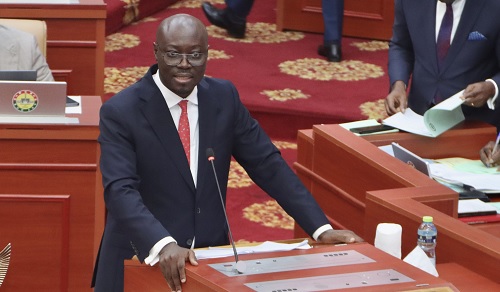
Presenting the Ghana Accelerated National Reserve Accumulation Policy (GANRAP) (2026–2028) to Parliament on Wednesday, February 25, the Minister for Finance, Dr Cassiel Ato Forson, said the policy marked the first comprehensive and deliberate national framework aimed at sustainably building external reserves and securing long-term macroeconomic stability.
He told lawmakers that the initiative represents a historic shift away from short-term, debt-driven reserve accumulation towards a structured, gold-backed and reform-led approach. According to him, the policy builds on what he characterised as a decisive macroeconomic recovery in 2025 following the 2022–2023 crisis.
Dr Forson pointed to real GDP growth averaging 6.1 per cent in the first three quarters of 2025, while inflation fell sharply from 23.8 per cent in 2024 to 5.4 per cent and further to 3.8 per cent in January 2026. The 91-day Treasury bill rate declined from 27.7 per cent at the end of 2024 to 6.4 per cent in February 2026, while public debt dropped from 61.8 per cent of GDP to 45.3 per cent. Gross international reserves also rose to US$13.8 billion, equivalent to 5.7 months of import cover, up from 4.0 months in 2024.
Despite the improvement, the minister cautioned that the traditional benchmark of three months of import cover was no longer adequate in an increasingly volatile global environment marked by commodity price swings, geopolitical tensions and climate-related disruptions.
Under GANRAP, the government is targeting reserves equivalent to 15 months of import cover by the end of 2028. The policy sets intermediate milestones of 8.6 months by end-2026 and 11.8 months by end-2027. Dr Forson described the target as the creation of an “economic war chest” to protect Ghana against commodity price shocks, global financing volatility, geopolitical tensions and climate-related disruptions.
Central to the strategy is a deliberate gold-backed reserve accumulation framework anchored on the Ghana Gold Board Act, 2025 (Act 1140). The law mandates the Ghana Gold Board to generate foreign exchange and support gold reserve accumulation by the Bank of Ghana.
Government has set an operational weekly gold purchase target of approximately 3.02 tonnes. This will be achieved through the acquisition of at least 2.45 tonnes weekly from the Artisanal Small-Scale Mining sector and the invocation of pre-emption rights to secure a minimum of 0.57 tonnes weekly from the large-scale mining sector. The gold acquired will be refined and added to Ghana’s physical reserves, and may only be sold with prior approval of Cabinet and Parliament.
Dr Forson contrasted the new model with what he described as an expensive and unsustainable approach to reserve building in recent years. Between 2017 and 2024, Ghana relied heavily on Eurobonds, swaps, sale-and-buy-back transactions and commercial bank borrowing to shore up reserves. From 2022 to 2024 alone, the Bank of Ghana accumulated US$5.65 billion in reserves through swaps and related transactions at a cost of US$1.16 billion in interest.
He added that Eurobond borrowings between 2018 and 2021 to support reserve build-up cost taxpayers about US$2.5 billion in interest payments alone, with the country still servicing those debts. Borrowing to accumulate reserves, he stressed, was unsustainable and contributed to the 2022 debt distress.
In contrast, the minister revealed that in 2025 alone, the Ghana Gold Board generated approximately US$10 billion in foreign exchange at a cost of US$214 million, significantly lower than the cost of comparable borrowing. He argued that the new framework would entrench discipline in reserve management and provide a more resilient buffer for the economy over the medium term.
The policy now places Parliament at the centre of oversight, with sales of accumulated gold reserves subject to approval, a move the government says is intended to prevent politically motivated drawdowns and safeguard long-term stability.
