
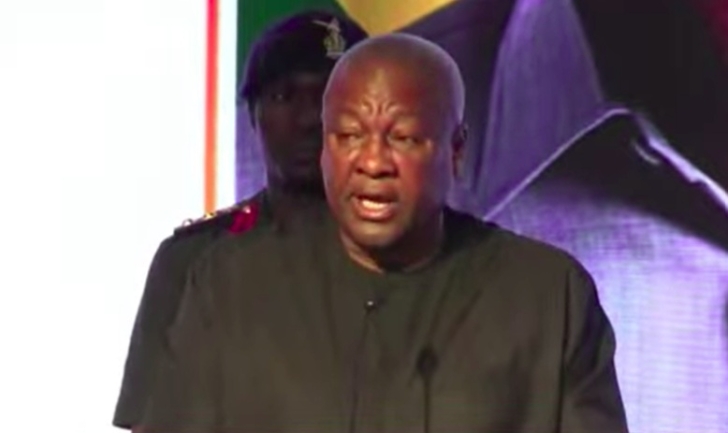
President John Dramani Mahama has unveiled Ghana’s National Artificial Intelligence Strategy, setting out an ambitious roadmap to position the country as a leading hub for AI innovation in West Africa and across the continent.
Launching the strategy in Accra on Friday, April 24, President Mahama described the initiative as a defining step in Ghana’s transition towards a digitally driven economy, stressing that the country must move beyond passive consumption of emerging technologies to actively shaping their development and deployment.
“This is a significant milestone in our national journey towards a digitally empowered, innovation-driven and globally competitive Ghana. It is also a statement of intent that Ghana will not be just a passive consumer of technologies shaping the future but that we are going to be an active participant in designing, governing and deploying them for our national transformation,” he said.
$270 million investment to drive AI agenda
Central to the strategy is a $270 million investment package aimed at building the infrastructure required to support Ghana’s AI ambitions. Of this amount, $250 million has been earmarked for the establishment of a national artificial intelligence computing centre, with an additional $20 million allocated to fund the short- to medium-term implementation of the strategy.
President Mahama said the proposed facility would serve as a hub for research, innovation and enterprise development, enabling local talent to create solutions with relevance beyond Ghana’s borders.
“Infrastructure is the foundation upon which innovation rests. Ghana will invest $250 million to establish a world-class AI computing centre. In addition, government will commit $20 million to support the short to medium-term National AI strategy. These investments are bold but necessary,” he stated.
Institutional framework and governance focus
The strategy also outlines the creation of new institutions to oversee the ethical and coordinated rollout of AI systems. According to Prof. Jerry John Kponyo of the Kwame Nkrumah University of Science and Technology, plans are underway to establish an independent Responsible AI Authority within the first year, alongside a national AI office under the Ministry of Communication, Digital Technology and Innovation.
A National AI Fund is also being proposed to provide sustainable financing for research, innovation and long-term implementation.
Collaboration key to success
The Minister for Communication, Digital Technology and Innovation, Samuel Nartey George, underscored the need for collaboration across government, academia, industry and civil society, noting that artificial intelligence is already transforming sectors including healthcare, agriculture, education and finance.
“I trust that the judiciary will guide our ethical and legal application of artificial intelligence. Ghana stands capable and ready of leading and becoming Africa’s AI hub by strengthening collaboration between government, industry, academia and citizens. We will build a Ghana that owns its future in the age of intelligence,” he said.
He added that the strategy reflects a collective national effort and positions AI not merely as a technological upgrade but as a tool for broad-based socio-economic transformation.
Ethical concerns and inclusivity
Speaker of Parliament Alban Bagbin cautioned that while AI presents significant opportunities, it also carries risks if not properly regulated. He warned that unchecked deployment could deepen inequality, weaken social trust and threaten democratic values.
“Artificial intelligence can unlock productivity, improve public service delivery, enhance scientific discovery, and expand economic opportunity,” he said. “At the same time, if left unchecked or poorly governed, it can deepen inequality, weaken social trust, threaten privacy, and marginalise the most vulnerable among us.”
He stressed that the national strategy must be treated as a broader social contract aimed at ensuring that technological progress aligns with human development and inclusivity.
Capacity building and national readiness
A key pillar of the strategy is capacity development, with a focus on strengthening STEM education, supporting research institutions and equipping the public sector to integrate AI into governance and service delivery.
President Mahama revealed that ministers and senior officials had already undergone a national AI boot camp to deepen their understanding of emerging technologies and drive implementation across ministries.
The government has also designated AI focal persons within ministries to lead adoption efforts, signalling a coordinated approach to embedding artificial intelligence within public administration.
With the launch of the strategy, Ghana is seeking to strengthen its position in the global digital economy, balancing innovation with ethical governance as it pursues long-term technological transformation.
