
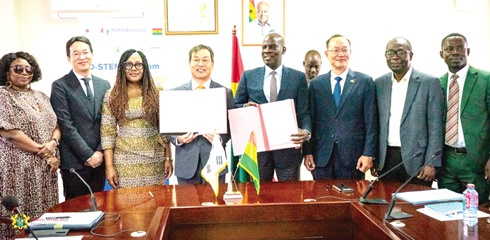
Ghana and the Republic of Korea have signed a Memorandum of Understanding (MoU) to strengthen Digital STEM education in Ghana.
The MoU seeks to implement the second phase of the Digital Science, Technology, Engineering and Mathematics (D-STEM) Education project, with the Republic of Korea committing US$28 million to support the initiative.
Building on the achievements of the STEM Phase I Project, the new programme will expand coverage to the Eastern, Central, Northern and Ashanti regions, targeting junior high school students in 12 districts and 713 schools across the beneficiary regions.
The six-year project, which will run from 2026 to 2032, will also include the construction of the Accra STEM Park, the strengthening of the Northern STEM Resource Centre and the integration of digital technologies into STEM education.
The Minister of Education Haruna Iddrisu and the KOICA Country Director Donghyun Lee signed the MoU and was witnessed by the Korean Ambassador to Ghana, Gyongsig Park.
Project objective
The D-STEM Programme is guided by three core objectives of improving mathematics and science teachers’ digital-integrated STEM teaching capacity, improving JHS students’ access to digital education and enhancing awareness of digital-integrated STEM education among stakeholders and communities.
To achieve the objectives of the project, the programme interventions will, among others, focus on the institutionalisation of Teacher Learning Circles (TLCs), scaling up the collaborative, subject-specific platform piloted under the STEM Phase I to strengthen peer learning among mathematics and science teachers.
It will also focus on smart schools and tablet deployment for JHS students, introducing digital learning tools and devices into participating classrooms.
Improvement in learning outcomes
Speaking during the signing ceremony in Accra, Mr Iddrisu described education as the cornerstone of national development, stressing that every investment in education was an investment in Ghana's future.
He said the first phase of the project, implemented between 2021 and 2025 in the Central and Eastern regions, had produced significant improvements in learning outcomes, with participating schools recording a 22.6 percentage-point increase in the BECE Mathematics pass rate and a 10.5 percentage-point improvement in Science.
Mr Iddrisu said the second phase, dubbed “Digital STEM for All,” would prepare learners with digital skills through the introduction of robotics, coding, electronics and artificial intelligence at the basic education level.
He announced that the ministry would launch a revised curriculum for kindergarten to junior high school before September 30, with digital education as a key component.
The minister expressed appreciation to the Government of the Republic of Korea and the Korea International Cooperation Agency (KOICA) for their continued support and called on all stakeholders to ensure the successful implementation of the project.
Investment in education
For his part, Mr Park said Korea's economic transformation had been driven by investment in education and human capital, making education a key pillar of the country's development cooperation.
He noted that the success of the first phase had informed the decision to support a second phase with a stronger emphasis on digital STEM education and expressed confidence in the Ministry of Education's ability to deliver the project successfully.
The KOICA Country Director, Dong Hyun Lee, reaffirmed KOICA's commitment to supporting Ghana's education sector, saying the integration of digital technology into STEM education would be a major milestone in preparing Ghanaian learners for the future.
He assured the Government of Ghana of KOICA's continued support to ensure the successful implementation of the project.
