
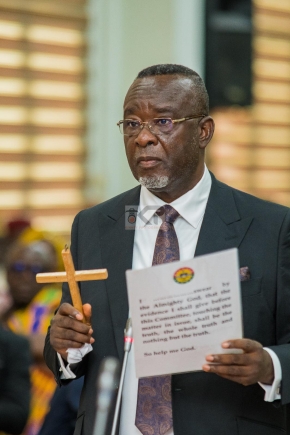
The Member of Parliament for Ofoase Ayirebi, Kojo Oppong Nkrumah, has filed a suit at the Supreme Court challenging the constitutionality of administrative warrants issued by the Chief Justice directing selected High Court judges to sit and conduct criminal trials during the legal vacation.
The writ, filed on Friday, August 14, 2026, names the Chief Justice, Paul Baffoe-Bonnie, as the first defendant and the Attorney-General and Minister for Justice, Dominic Ayine, as the second defendant.
Mr Oppong Nkrumah is invoking the original jurisdiction of the Supreme Court under Articles 2(1) and 130(1) of the 1992 Constitution, seeking declarations that the administrative warrants issued by the Chief Justice are inconsistent with the Constitution and are therefore null and void.
“A declaration that the action of the Honourable Chief Justice to promote and facilitate the hearing of “special criminal cases” in the legal vacation to the total neglect of other criminal cases is tantamount to selective justice which contravenes the letter and spirit of Article 17(1) of the Constitution 1992 and therefore unconstitutional, null and void.”
At the centre of the case are warrants directing selected criminal cases to be heard during the legal vacation, which runs from August 1 to September 30, 2026.
In his statement of case, Mr Oppong Nkrumah said his action was not directed at the constitutional authority of the Chief Justice to administer the Judiciary or regulate the sittings of the courts.
“The Plaintiff readily acknowledges that the office of the Chief Justice occupies a unique constitutional position as the head of the Judiciary and is entrusted with broad administrative responsibilities for the effective and efficient functioning of the courts,” the statement said.
However, he argues that the exercise of such administrative powers must remain subject to the Constitution.
“It is a cardinal principle of Ghana’s constitutional order that every constitutional power, however extensive, is subject to the supremacy of the Constitution,” he said
“The Constitution does not recognise absolute or unreviewable discretionary power. Every public authority, including the Chief Justice, must exercise administrative and discretionary powers in a manner that is fair, reasonable, transparent, non-arbitrary and consistent with the Constitution,” the statement added.
Mr Oppong Nkrumah contends that the warrants have the practical effect of giving priority to selected criminal cases while other pending criminal cases remain outside their scope.
According to him, “The impugned warrants have the practical effect of according priority to selected criminal cases while other pending criminal cases remain outside the scope of the warrants.”
He further argues that the arrangement creates an arbitrary classification among similarly placed criminal proceedings, accused persons and litigants.
The MP is therefore asking the Supreme Court to determine whether the Chief Justice’s decision to issue the warrants directing selected High Court judges to hear criminal cases during the legal vacation is constitutionally valid.
The case also seeks declarations that the warrants issued for the period from August 1 to September 30, 2026, are inconsistent with the 1992 Constitution and are consequently null and void.
credit: Citinewsroom
