

Minerals Commission records early gains as Anyimah drives anti-galamsey strategy
Ghana’s long and often frustrating battle against illegal mining is entering a more structured phase as the Minerals Commission deploys manpower, technology and community-based surveillance to contain the scourge.
At the centre of the operational push is Emmanuel Anyimah, Deputy Chief Executive of the Minerals Commission in charge of Support Services, whose oversight of logistics, finance, recruitment and deployment has become a key engine of the government’s anti-galamsey campaign.
Working alongside the Commission’s Chief Executive, Isaac Andrews Tandoh, and under the policy direction of Lands and Natural Resources Minister, Emmanuel Armah-Kofi Buah, Mr Anyimah is spearheading an approach that prioritises durable systems over short-lived enforcement operations.
“The President and the Minister of Lands were clear that enforcement must work this time,” Mr Anyimah said. “Our responsibility at the Commission is to build structures that remain in place, not exercises that come and go.”
Building enforcement presence
The most visible expression of that strategy is the Blue Water Guard initiative, a community-based surveillance programme designed to protect rivers, forest reserves and mining concessions from illegal activity.
Unlike previous crackdowns that relied largely on periodic military-style operations, the programme embeds trained personnel within mining districts to provide continuous monitoring and intelligence.
Mr Anyimah oversees the entire operational chain, from recruitment and vetting to training, financing and deployment. More than 1,600 personnel have already been deployed nationwide, with plans to expand the number to over 2,000.
The guards operate unarmed and focus on surveillance and environmental protection, feeding intelligence to security agencies coordinated through the National Anti-Illegal Mining Operations Secretariat (NAIMOS).
“We didn’t want a symbolic programme,” Mr Anyimah explained. “We wanted something structured and accountable, with people permanently assigned to the communities they protect.”
The initiative has been backed with approximately GH¢4 million in funding, including about GH¢3.2 million in monthly wages, effectively transforming enforcement into a standing operational system rather than an ad hoc intervention.
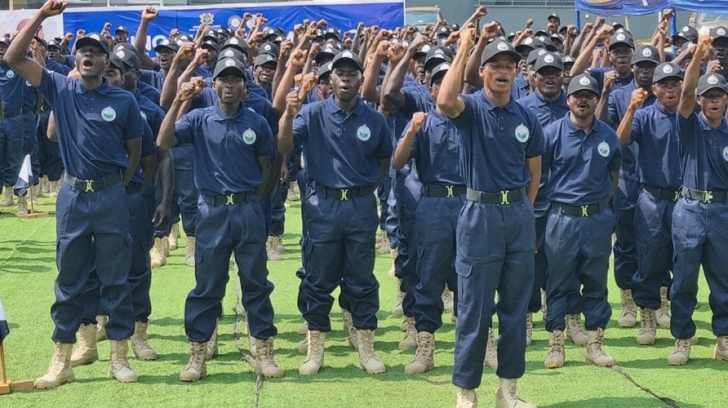
Deployments currently span major mining regions, including the Western, Western North, Ashanti, Eastern, Central, Volta, Northern, and Savannah zones, and cover communities along key river basins such as the Pra and Black Volta.
“Illegal mining thrives in gaps,” Mr Anyimah said. “If enforcement disappears for two weeks, they return. So we are ensuring there is always someone on the ground.”
Technology closing loopholes
Alongside manpower deployment, the Minerals Commission is strengthening oversight through technology: more than 2,000 excavators are currently tracked in a digital monitoring system, and an additional 3,000 trackers are being procured to expand coverage.
Under proposed amendments to the Minerals and Mining Act (Act 703), excavators will be registered and geofenced to specific mining concessions, allowing regulators to detect when equipment moves outside authorised boundaries.
“If an excavator leaves its permitted site, we know immediately,” Mr Anyimah said. “That is usually the first sign of illegal activity. We are moving from reacting after damage occurs to preventing it in real time.”
Early signs of recovery
The structured approach is already producing measurable results. Data from the Ministry of Lands and Natural Resources indicate significant improvements in water quality across several rivers previously affected by illegal mining.
At River Tano in Sefwi, turbidity levels fell dramatically from 139 NTU in 2024 to 14 NTU in 2025, representing an 89 per cent reduction.
Other rivers, including the Barekese, Ankobra, and Densu, have also recorded notable improvements, signalling the gradual recovery of water bodies long polluted by illegal mining.
Authorities say cleaner rivers reduce water treatment costs, improve agricultural conditions and enhance public health outcomes.
Restoring damaged landscapes
Beyond enforcement, the government is pursuing large-scale land reclamation projects to rehabilitate degraded mining areas.
At Manso Nyankomanse in the Ashanti Region, about 320 hectares of mined-out land have been successfully restored under ongoing reclamation initiatives.
Officials say the project demonstrates that landscapes damaged by illegal mining can be returned to productive use.
Recognising that enforcement alone cannot solve the problem, the government is also promoting regulated community mining.
Through initiatives such as the Responsible Cooperative Mining and Skills Development Programme (rCOMSDEP), organised community groups are being allocated designated concessions to mine responsibly away from rivers and environmentally sensitive areas.
The structured cooperative model is expected to improve oversight, formalise small-scale mining and enhance the traceability of gold production, a critical requirement for meeting international responsible sourcing standards.
For the Minerals Commission, improved traceability could also strengthen investor confidence in Ghana’s mining sector by aligning operations with global environmental, social and governance (ESG) standards.
Strengthening the institution
Beyond field operations, Mr Anyimah is also leading efforts to reinforce the commission’s internal capacity. Recovering outstanding licence fees, strengthening financial controls and decentralising the Commission’s presence through district-level offices are part of the institutional reforms underway.
The expansion of district offices is expected to enhance regulatory oversight and create new technical and administrative roles, including opportunities for graduates of the University of Mines and Technology (UMaT) and the Kwame Nkrumah University of Science and Technology (KNUST).
For Mr Anyimah, the success of the anti-galamsey campaign will ultimately depend on the durability of the systems being built today. “You cannot solve this with one operation,” he said. “You build systems, and the systems do the work.”
