
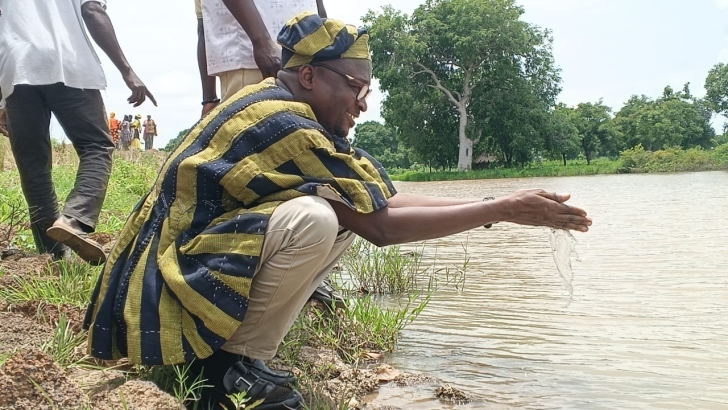
For many years, the search for water was a daily struggle for residents of several farming communities in the North East Gonja District of the Savannah Region.
Women and children often spent hours walking long distances in search of water, particularly during the dry season when existing sources dried up, affecting household activities, sanitation, and livelihoods.
That challenge is expected to ease following the construction of a new small earth dam at Kanjeyili and the rehabilitation and expansion of the Yakura small earth dam by Saha Global, a non-governmental organisation based in Ghana.
The projects, undertaken in partnership with the Member of Parliament for Salaga North and the North East Gonja District Assembly, with funding support from Water Harvest and Shockwave Foundation, cost about GH¢1.8 million.
The intervention is expected to provide a reliable year-round water source for more than 14 farming communities, as well as commercial water tanker operators who supply water to parts of Tamale.
Relief for communities
Before the intervention, residents of communities such as Sakpalua, Kpinchila, Kpandu, Buhijaa, Yakura and Fushilla relied on seasonal water sources that frequently dried up during prolonged dry spells.
The burden fell heavily on women and children, who spent long hours fetching water, often at the expense of productive work and education.
The scarcity also affected sanitation and hygiene practices and constrained agricultural activities, particularly livestock production and dry-season farming.
The newly constructed Kanjeyili Dam and the expanded Yakura Dam are expected to improve access to water for domestic use, livestock watering and vegetable cultivation, while reducing the time spent searching for water.
Residents believe the intervention will enable women to engage in income-generating activities and allow children to devote more time to their studies.
The project was executed by Bornsa Construction Works and completed in July this year.
Sustainable solution
Speaking at the commissioning ceremony, the Government and Stakeholder Relations Manager of Saha Global, Blessing Francis Gbandan, described the dams as a major step towards ensuring sustainable access to safe water for underserved communities.
He explained that although Saha Global had for years provided surface water treatment systems in remote communities, many water bodies dried up during the dry season, making water treatment impossible when it was most needed.
“When reservoirs dry up, communities are left with mud instead of water, forcing residents, particularly women and children, to travel long distances in search of water,” he said.
Mr Gbandan said the organisation strengthened collaboration with district assemblies and development partners to secure long-term solutions to water insecurity.
He noted that the expanded reservoirs had been designed to store substantial volumes of water throughout the year to support water treatment and domestic use.
He expressed optimism that the projects would improve public health, strengthen livelihoods and contribute to the socio-economic development of beneficiary communities.
Commendation
The Member of Parliament for Salaga North, Alhaji Alhassan Mumuni, commended Saha Global and its funding partners for supporting efforts to address water challenges in the district.
He said the dams would improve access to water, promote economic activities, and strengthen social cohesion among beneficiary communities.
According to him, the North East Gonja District continues to face developmental challenges, including poor road networks, water shortages, and weak telecommunications connectivity, particularly in hard-to-reach areas.
Alhaji Mumuni urged residents to establish community management committees to protect and maintain the facilities to ensure their long-term sustainability.
“This investment is intended to improve livelihoods and create opportunities for economic growth. Beneficiary communities must therefore take ownership of the facilities and protect them for future generations,” he said.
For residents who have endured years of water scarcity, the completion of the two dams represents more than infrastructure. It offers renewed hope for improved sanitation, healthier families and sustainable livelihoods.
