
Calls to scrap OSP premature: President Mahama declares - Demands speeding up of prosecutions
President John Dramani Mahama has called on the Office of the Special Prosecutor (OSP) to expedite its investigations and demonstrate its relevance through tangible results.
The President stated that while people were eager to see more prosecutions, it was premature to call for the closure of the office.
"I think it's premature to call for the closure of that office.
So, I think we should give them a little time. Of course, people want to see more prosecutions and more results.
And so I'll just urge the OSP to speed up some of these investigations and show people that the office is still very relevant," the President said.
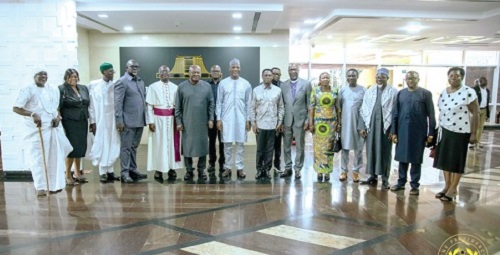
He made those remarks during a meeting with the Governing Board of the National Peace Council at the Presidency yesterday, a meeting intended to familiarise the President with the council's work.
The meeting had the Minister for the Interior, Muntaka Mohammed-Mubarak, and other government officials present.
Context
The OSP has come under scrutiny lately for what critics consider as failure to deliver on its mandate in spite of the heavy budget allocated to the office annually.
Indeed, a number of petitions have been submitted to the President to remove the Special Prosecutor, Kissi Agyebeng, in particular over a wide range of issues.
Recently, outspoken private legal practitioner, Martin Kpebu, accused Mr Agyebeng of various shortcomings, including complicity in how former Finance Minister, Ken Ofori-Atta, left the country without any effort to restrain him to face charges of corruption and corruption-related offences.
Peace Council mandate
President Mahama, who was Vice-President during the formation of the National Peace Council, commended the institution for its unique and admired role in Ghana's peace architecture since 2011.
He, however, expressed deep concern over the proliferation of conflicts across the country, largely driven by chieftaincy and land disputes, saying those incidents were straining national security resources.
"A lot of our security services are tied down in conflict areas. I mean, Sampa, we have a whole contingent there.
You go to Nkwanta, we have a whole contingent there. You go to Bawku, we have a whole contingent there.
Recently, Savannah, we had a whole contingent there; we have not withdrawn them yet," he stated.
President Mahama added that these conflicts had become a "major, major headache for governments".
To address this, he stressed the need to properly resource the National Peace Council to arbitrate such disputes.
He consequently announced support for the establishment of a permanent headquarters for the council and the establishment of a Peace Fund.
"We'll look at the issue of the peace fund, and we'll work together to see how we can kick-start it and populate the fund with some resources," he assured.
National context
In the broader national context, President Mahama linked economic stability to conflict prevention, citing his government's focus on stabilising the economy.
"The economy is appearing stable; inflation has come down to single digits, the cedi has appreciated in value, and cost of living has slowed down," he said.
Touching on regional security, the President warned that Ghana was not immune to the threat of violent extremism from the Sahel or to internal democratic disillusionment.
"Ghana is not immune to coups,” he said, stressing that such events occurred when society had lost faith in the prevailing system.
He consequently underscored the government's commitment to regaining public trust through accountability and by resourcing anti-corruption institutions.
He revealed that a mediation report on the long-standing Bawku conflict, undertaken by the Asantehene, would be presented to stakeholders, including the National Peace Council, on Tuesday, December 16, 2025, to pave the way for decisive action on the subject.
President Mahama touched on the constitutional review process, confirming that the committee's final report would be presented on December 22 this year.
"Once the final report is presented, we would, you know, make it known to the rest of the nation," he said.
