
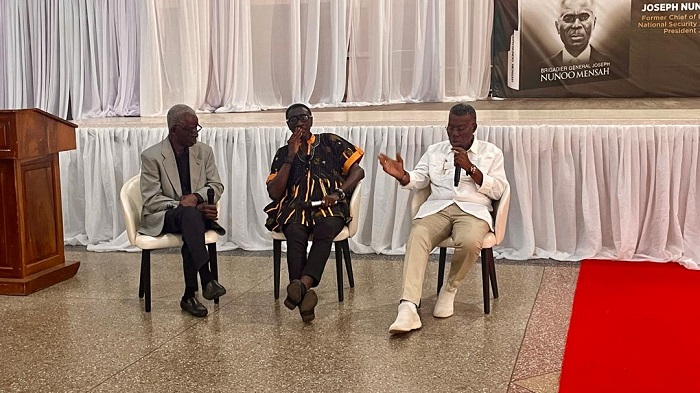
Former Chief of Defence Staff, Brigadier General Joseph Nunoo-Mensah, has called for what he described as a moral reset in Ghana, cautioning that weakening discipline, growing materialism and the erosion of communal values are shaping a generation without firm guidance.
He said the country must deliberately return to principles of honesty, hard work and respect if it is to secure a stable future for its young people.
Brigadier General Nunoo-Mensah made the remarks at the launch of his memoir, My Memoirs: I Don’t Follow the Crowd, at Christ the King Catholic Church in Accra on Friday, February 20, 2026.
“I generally worry about the future,” he told the audience. “What kind of world are you going to leave to our children and grandchildren?”
Reflecting on changes in society, he said the sense of love and humanity that once defined communities appeared to be fading.
He questioned whether the current generation was being equipped with the right moral compass, arguing that leadership begins at home and in everyday conduct.
Responding to questions from broadcaster Kwaku Sintim-Misa on what concerned him most about the present generation, he said young people today face intense social pressure, including the public display of wealth and the pursuit of quick recognition.
He contrasted that with his upbringing in Winneba, where he undertook menial jobs, including loading cocoa and working as a driver’s mate to fund his education.
“We were taught discipline and truthfulness,” he said. “Those were non-negotiable.”
A biographical profile presented at the event traced his rise from modest beginnings to the pinnacle of the Ghana Armed Forces. After enlisting in 1960, he was selected for officer training at the Royal Military Academy Sandhurst in the United Kingdom, where he emerged as the best overseas cadet and won the academic sword.
He later became Chief of Defence Staff in 1979 under the Armed Forces Revolutionary Council and was reappointed in 1982 under the Provisional National Defence Council, becoming the first Ghanaian officer to hold the position on two separate occasions. In November 1982, he resigned on principle, maintaining that soldiers should not remain entrenched in political governance.
Brig Gen Nunoo-Mensah subsequently served as National Security Advisor under President John Evans Atta Mills and continued under President John Dramani Mahama until 2013.
Entrepreneur and political figure Nana Kwame Bediako, popularly known as Cheddar, paid tribute to the retired General, describing him as a rare elder who openly supports younger leaders with conviction rather than convenience.
He recounted how Brigadier General Nunoo-Mensah stood with him publicly at a defining moment in his political journey, saying the gesture carried moral weight.
Mr Bediako further announced that he would personally take responsibility for the cost of publishing the memoir, explaining that the gesture was his way of honouring a man he considers principled, bold and consistent in thought and action.
Chairing the ceremony, Colonel Benjamin Ahlijah rtd described the memoir as an important national document that goes beyond personal recollection to offer insight into critical moments in Ghana’s military and political history.
He said the book provides a first-hand account of periods many Ghanaians only know through fragmented narratives, including military interventions and transitions to constitutional rule. According to him, such records are essential to deepening public understanding of the country’s past and strengthening democratic culture.
Colonel Ahlijah urged public institutions, libraries and the academic community to support the documentation of Ghana’s history through personal memoirs, noting that when those who witnessed pivotal events fail to write, future generations are left with incomplete accounts.
He formally launched the book and encouraged Ghanaians to read it not only for its historical value but also for its lessons on courage, discipline and independent thought.
