
Easter public prayers and the search for national development (Part 1)
For many Christians, Easter is the most important date in the calendar.
Christmas may be more popular and is certainly more commercialised. Easter is widely seen as representing the core theological foundation of Christianity: the resurrection of Jesus Christ.
Reflecting Easter’s importance, public prayers take place, encouraged by statutory public holidays on Good Friday and Easter Monday.
These gatherings serve as opportunities not only for national reflection, worship, and to celebrate the crucifixion and resurrection of Jesus Christ, but also as a time for mass worship, reflecting on themes of sacrifice, love and forgiveness.
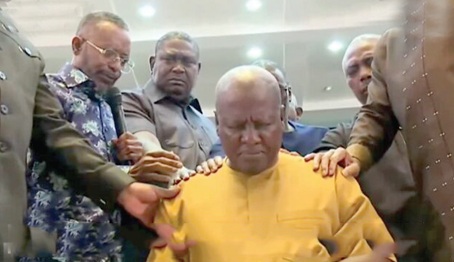
Public prayers, including at Easter, are a central part of Ghana’s religious and cultural life.
Some critique public prayers, claiming they have a negative impact on economic productivity, public health, and social noise levels.
Although deeply ingrained, practices such as all-night services and ‘aggressive prayer’ are subjects of debate among politicians, religious leaders and the public.
Public prayer
Public prayers are intertwined with governance, functioning as a key component of political legitimacy, national identity and policy implementation. Following redemocratisation in the Fourth Republic, governments have formalised public prayers, beginning with President John Evans Atta-Mills’ establishment of a ‘National Day of Prayer’ in 2009, along with ‘prayer camps’, in support of the NDC’s victory in the presidential election.
President Atta-Mills also expressed his hope that all of Ghana would be a prayer camp, that is, an environment where public prayers would be ubiquitous.
Today, public prayers are used to launch government initiatives, with leaders calling for spiritual support to ensure economic stability and national development.
Christian leaders may employ public prayers to exercise a ‘prophetic voice’, using the opportunity to condemn corruption and assert the public necessity of holding the politically powerful leaders accountable.
In addition, public prayers are widely used to promote national unity and peace, particularly following security threats.
Prayer and thanksgiving
Soon after coming to power in January 2025, President John Dramani Mahama established a National Day of Prayer and Thanksgiving.
The President appointed Elvis Afriyie Ankrah, a former NDC Minister for Youth and Sports, as Presidential Envoy for Interfaith and Ecumenical Relations, and one of his roles was to encourage public prayers and to take part in them as President Mahama’s representative.
Earlier this year, the presidential envoy addressed a ‘momentous gathering’ at the Christ Apostolic Church International’s Annual Ministerial Prayer Conference, held at Asamankese in the Eastern Region, which focused on ‘growth, unity, and the advancement of God’s work’.
Mr Ankrah called on church ministers to use their spiritual gifts for national renewal and for political leaders to encourage national solidarity, aiming to blend a sense of national identity with spiritual life to encourage national development.
Critiques
Utilisation of public prayer as a means to influence governance faces criticism on three main counts.
First, critics regard public prayer, nearly always led by Christians, as an attempt to reconfigure and ‘Christianise’ Ghana’s public and private morality and further the idea that Christianity is synonymous with national identity.
Second, critics contend that public prayer is a manipulative tool employed by the government to distract people from policy failures and inadequacies.
Third, critics contend that public prayer is divisive and does not encourage a sense of national cohesion among Ghanaians.
Supporters of public prayer, including those held at Easter, as well as during the National Day of Prayer and Thanksgiving, counter that they aim to bring together diverse religious groups, encourage coexistence and further communal harmony.
Encouraged both by the government and by leaders of the country’s major religious traditions, public prayer is said to encourage national development: unifying, state-sponsored, interfaith events promoting social stability, reconciliation and shared values across religious and political divides.
These gatherings, it is suggested, bring together leaders of Ghana’s main religious traditions to reinforce a sense of common national identity, encourage peace and advocate moral rectitude.
The second part of this article turns attention to the impact of public prayer on Ghana’s national development, a multi-dimensional process aimed at raising living standards, reducing poverty, and accelerating economic growth through strategic planning.
The question is, to what extent, if at all, does public prayer at Easter and at other times encourage economic transformation, infrastructural improvements, educational advances, and the strengthening of democratic governance?
The writer is an Emeritus Professor of Politics, London Metropolitan University, UK.
