
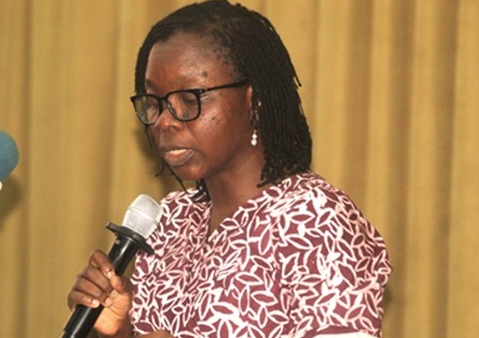
The Citizens’ Platform on Constitutional Reform (CPCR) has called on the government to commit to a clear implementation roadmap backed by law to safeguard the process.
“As the very first step in this process, we ask the government to introduce and secure the passage of a Constitutional Reform Implementation and Roadmap Act,” she said.
That, it explained, was based on past experiences, where the country failed to follow through with amendments put together by the Professor E. V. O. Dankwa committee in 2012 and the failed attempts in 2029 concerning local government reforms.
“We believe that as a country, we must all learn from those lessons and act differently now to safeguard the process,” she said.
Position paper
The Chairperson of the CPCR Steering Committee, Prof. Akosua Keseboa Darkwah, made the call at a press conference in Accra last Tuesday to present the CPCR position paper on the constitutional review process and the government’s position paper on the Kwasi Prempeh Constitution Review Committee.
The CPCR is a collaborative initiative facilitated by CDD-Ghana, STAR-Ghana Foundation and the Democracy Hub, bringing together diverse organisations, activists and citizens to coordinate engagement, advocacy and accountability in Ghana’s ongoing constitutional reform process.
Prof. Darkwah further called on the government to clarify the mandate for the Implementation Committee.
“We are asking that its mandate be openly defined as one of genuine consensus building, with the authority to recommend changes to the government’s own positions where the national interest requires it,” she said.
She said the platform was asking the government to commit now not to place more than 20 amendments before the country as one package, with one “Yes” or “No” answer.
“These amendments deal with very different questions, ranging from the term of the President to the funding of local government. It is probable that a person may support one of these changes and strongly oppose another.
This is why the referendum must allow that person’s vote to reflect those different views,” she stated.
In addition, she said the questions must also be written in plain language to ensure that every voter would be able to understand exactly what each vote would change and what it would leave untouched.
Citizens
Prof. Darkwah urged the citizenry to take an active interest in the ongoing process to review the 1992 Constitution.
“Constitutional reform cannot be left only to politicians, lawyers or experts.
The decisions being considered will affect every citizen and shape the way our country is governed for many years.
Prof. Darkwah, therefore, urged Ghanaians not to wait until the referendum before becoming involved.
“This is the time to follow the process, participate in the discussions and insist that any changes made to our Constitution reflect the considered will of the people,” she stated.
Civic education
Prof. Darkwah also asked the government to set aside funds for civic education, to be protected by law, led by the National Commission for Civic Education, and to be released well before the referendum.
She explained that for the referendum to succeed, the Constitution requires that at least 40 per cent of all registered voters take part and that 75 per cent approve the proposals.
“Those are very high thresholds which cannot be cleared by a campaign squeezed into the final weeks.
The public must have enough time to consider each question before the referendum is held,” she stressed.
