
Tomatoes, insecurity and climate crisis
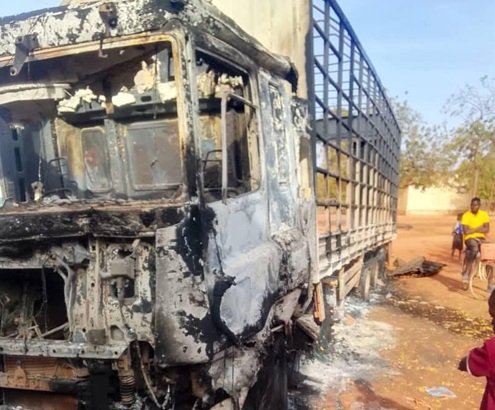
The killing of eight Ghanaian tomato traders in Burkina Faso on February 14 raises urgent questions about whether Sahelian insurgency is edging towards Ghana’s northern frontier.
The slayings sent shock waves through Ghana, while unsettling a trade corridor which feeds thousands across West Africa and challenging the view that Ghana is an anchor of regional stability.
The tragic deaths raise two related questions of crucial importance for Ghana’s security.
First, why do Ghanaians have to travel to Burkina Faso to buy tomatoes?
Why does Ghana not grow sufficient tomatoes for home consumption?
Second, what are the links between Ghana’s worsening food security and the climate crisis?
Climate crisis and food production
Ghana struggles to produce enough tomatoes for local consumption due to a heavy reliance on rain-fed agriculture, leading to severe seasonal shortages, high post-harvest losses (30-50%), and significant damage from pests and diseases like bacterial wilt.
Inadequate irrigation infrastructure, lack of cold chain storage, and high costs of inputs prevent year-round production, forcing traders to make the hazardous journey to Burkina Faso for alternative supplies.
In the Upper East Region, Navrongo and Zebilla are known for dry-season farming.
Local farmers utilise irrigation systems (such as dugouts and Tono/Vea schemes) to grow tomatoes from December to May. But things are changing.
The climate crisis is manifesting as severe droughts, erratic rainfall, and rising temperatures, driving agricultural failure, food insecurity, and increased poverty.
The region also faces intensified seasonal flooding, particularly from the White Volta River, while decreasing rainfall causes water scarcity. Environmental instability forces migration to the south.
These challenges mean that despite high demand and available land, local production is often not competitive, leading to a reliance on imports for food staples, including tomatoes, to meet local demand.
Politics of climate crisis
Ghana’s climate crisis significantly threatens food security by reducing yields of staples - such as maize, rice, and tubers – due to erratic rainfall, rising temperatures, and increased pest infestation.
With more than half of Ghanaians employed in agriculture, largely reliant on rain-fed systems, the sector faces severe disruptions, including potential 20% maize yield reductions by 2050.
Make no mistake: combating the climate crisis is a highly political issue linked to Ghana’s security.
The government must take the climate crisis seriously and rapidly devise a strategy to improve things.
Successive governments talk the talk of confronting the climate crisis, but do not, so far, walk the walk.
From Accra Reset Initiative to Africa Climate Dialogue
President John Dramani Mahama recently launched the Accra Reset Initiative (ARI), a new global development framework.
The ARI seeks to redefine Africa’s development agenda by reducing the continent’s reliance on external assistance and systems for security, social services, and foreign firms for mineral value chains.
Interestingly, President Mahama does not include climate change in his list of issues undermining development in Ghana and Africa more generally.
The Accra-based Africa Centre for Nature-Based Climate Action (AC4NCA; https://ac4nca.org/) recently launched the Accra Compact 2025 to ‘accelerate nature-based and people-centred climate action in Africa’.
The Compact highlights the dangers of climate crisis and suggests ways to combat it.
While ARI envisages a regional government-led framework to power a new global development model, AC4NCA focuses on civil society as key driver of solutions to climate crisis provoked instability and insecurity.
AC4NCA believes in the power of nature to provide sustainable, inclusive, and science-driven solutions to the climate crisis, championing Nature-Based Solutions (NbS) – actions that protect, enhance, and restore ecosystems while simultaneously addressing social challenges like poverty, gender inequality, and food insecurity.
In addition, AC4NCA believes in uplifting communities, empowering women and youth, supporting vulnerable populations, and promoting socio-economic development.
Climate crisis: What is to be done?
Both ARI and AC4NCA are initiatives focusing on the ability of Ghana – and Africa more generally – to thrive in a changing world, replete with serious security concerns.
Ghana, like Africa more generally, stands at the crossroads of climate vulnerability and possibility.
From the Sahel to the Congo Basin, from coastal mangroves to mountain ecosystems, the continent faces rising climate threats.
It also holds the world’s richest reserves of natural capital and community knowledge.
The ARI is a robust and focused framework to reposition Ghana – and Africa more generally – in a rapidly changing global environment.
ARI is to be welcomed.
But its silence on the climate crisis means that non-state efforts must step in to fill the gap.
It might seem a stretch of the imagination to link the tragic depths of eight tomato traders to the climate crisis threatening to engulf Africa in worsening insecurity and instability.
But this is the point we have now reached. Not words but meaningful actions are now desperately needed to mitigate the worst effects of the climate crisis.
Citizen initiatives such as AC4NCA are a good start, a positive indication that civil society working together can work wonders.
The writer is an Emeritus Professor of Politics, London Metropolitan University, UK
