
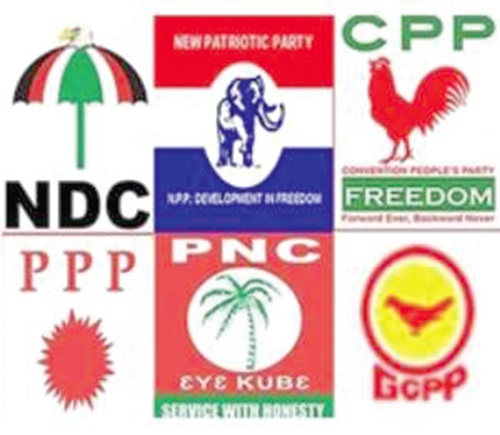
How do Ghanaians feel about political parties?
Political parties have an interesting history in Ghana.
Military interventions during the post-independence era always resulted in a ban on their activities.
A key step as part of the transition to multiparty democracy was the lifting of the ban on them and their activities.
The Fourth Republic has seen the longest uninterrupted history of political parties and their activities post-independence.
This is also because the 4th Republic has been the longest uninterrupted period of multiparty democracy since independence.
Such a long and uninterrupted history, plus the availability of 10 rounds (1999, 2002, 2005, 2008, 2012, 2014, 2017, 2019, 2022, 2024) of Afrobarometer survey data, allows a critical look at how Ghanaians feel about political parties and the implications for their role in sustaining the country’s democratic journey.
Seven Key Observations
Observation 1 – Ghanaians are growing less attached to political parties. In Round 1 (1999), seven out of 10 (67 per cent) expressed “feeling close” to a political party. By Round 6 (2014), this had dropped to six out of 10 (60%), further dropping to five out of 10 (45%) by Round 10 (2024).
In short, the percentage of Ghanaians who say they “feel close” to a political party has dropped significantly by 22 percentage points.
Observation 2 – Ghanaians strongly reject a one-party state.
When asked, “Would you disapprove or approve if only one political party is allowed to stand for election and hold office”, the percentage who disapprove/strongly disapprove has ranged between 78 per cent and 90 per cent between 1999 (Round 1) and 2024 (Round 10).
Observation 3 – The demand for more political parties has changed over time.
Between Round 2 (2002) and Round 5 (2012), the percentage of Ghanaians saying “many political parties are needed to make sure that they have real choices in who governs them” increased from 56 to 81 per cent.
Since then, it has dropped significantly to 69 per cent (Round 10, 2024).
Observation 4 - A strong majority of Ghanaians believe they are completely free to “join any political organisation they want.”
When the question was first asked in Round 4 (2008), 87 per cent answered “completely free”.
In the most recent year (Round 10, 2024), 80 per cent answered “completely free.”
Observation 5 – Ghanaians do not trust political parties, whether opposition or ruling.
Between Round 2 (2002) and Round 4 (2008), the percentage of Ghanaians trusting ruling parties “a lot” increased from 16 to 42 per cent. It then dropped to 18 per cent in Round 6 (2014).
After a rebound to 33 per cent (Round 7, 2017), it currently stands at 10 per cent (Round 10, 2024).
The same is true of opposition political parties.
The percentage of Ghanaians who trust them “a lot” increased from 5 per cent (Round 2, 2002) to 22 per cent (Round 4, 2008) and held steady at that percentage for the next two rounds (2012 and 2014).
Since then, the percentage of Ghanaians who say they trust opposition political parties “a lot” has dropped to 10 per cent (Round 10, 2024).
Observation 6: Any observation of the political space shows that opposition political parties tend to reflect their name well in terms of their relationship with the ruling party.
They typically oppose every single act of the ruling party. However, Ghanaians expect greater cooperation from opposition political parties.
The percentage of Ghanaians who say “once an election is over, opposition parties and politicians should accept defeat and cooperate with the government to help it develop the country” has increased significantly from 56 per cent (Round 4, 2008) to 66 per cent(Round 10, 2024).
Observation 7: Our political parties, especially the two dominant ones – National Democratic Congress (NDC) and New Patriotic Party (NPP), regularly compete for power during elections.
The country has seen various incidents of electoral violence over the years.
This is reflected in how Ghanaians feel about violence when it comes to political competition.
Between Round 2(2002) and Round 4 (2008), the percentage of Ghanaians saying political competition “often/always” led to political violence dropped from 54 to 32 per cent.
However, since then, the percentage of Ghanaians saying the same has increased significantly to 70 per cent (Round 9, 2022).
Takeaway for Political Parties
Political parties are an essential part of our democratic architecture.
Their role will continue to be pivotal as the country continues this path of democratic governance and strives for consolidation.
Political parties, therefore, have work to do.
These insights from the Afrobarometer survey point to two critical tasks, among many, for them.
First, political parties must work hard to rebuild trust between them and citizens.
Granted, citizens still go out to vote for them during elections, but the level of trust currently being expressed is a sign of worry which political parties must not overlook.
Second, political parties must eschew violence.
While there is the tendency to describe electoral violence as “isolated incidents”, political parties must be intentional in ensuring that it does not become normalised as part of political competition.
The writer is the Project Director, Democracy Project
