
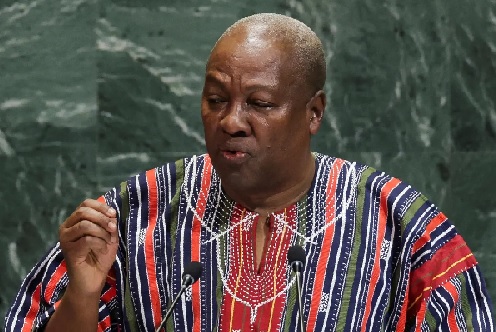
President John Dramani Mahama has called for a fundamental transformation in Africa’s relationship with the rest of the world, arguing that the continent must move from economic dependence to greater self-reliance, resource control and influence in global decision-making.
Speaking in an interview on TRT World’s Bigger Than Five programme on Friday, August 21, 2026, President Mahama said Africa’s current economic position was rooted in a global system that had left the continent heavily dependent on external assistance while limiting its control over the value of its natural resources.
Mahama described his proposed approach as an “Accra Reset,” saying Africa must reshape its engagement with the international community without turning its back on partnerships.
“We don’t reject partnerships, but those partnerships must be on our terms. We must have a greater say in what those resources are used for,” Mahama said.
From political liberation to economic liberation
The President said Africa had successfully fought the battle for political independence but that the continent’s present generation of leaders faces a different challenge: economic liberation.
“The challenge that us leaders of Africa today face is not the liberation struggle that was fought by Kwame Nkrumah and our forebears. It is the economic struggle,” he said.
Mahama argued that decades after independence, African countries continue to export raw materials while importing finished products, leaving much of the value generated from the continent’s resources outside Africa.
“And so we live on the handouts that the West gives us. And then, aside from that, we don’t control our resources. Our resources are bought at prices that are set by the West and exported. And the finished products are sent back to us at prices that are set by the West,” he stated.
He said breaking this cycle would require African countries to develop their productive capacity, process raw materials locally and create more value and jobs within their own economies.
‘Africa cannot continue to be a dependent continent’
According to Mahama, the problem extends beyond trade and natural resources to Africa’s broader position in the international system.
“Africa cannot continue to be a dependent continent. There are things we can do so that we’re able to have a better voice in global affairs,” he said.
He linked the argument to Ghana’s efforts to strengthen economic and health sovereignty. Mahama said African countries need more resilient health systems and greater local pharmaceutical production rather than relying excessively on external sources for essential medicines.
“We must create more resilient health systems. We must produce more of our medications locally in Africa. We must own our health outcomes more ourselves,” he said.
The President said the same principle should apply to the continent’s minerals, agricultural commodities and other strategic resources.
‘Africa’s prosperity is not a threat to anybody’
Mahama rejected the idea that a more prosperous and self-reliant Africa would come at the expense of other parts of the world.
“Africa’s prosperity is not a threat to anybody. Indeed, Africa’s prosperity will be a benefit to the whole global economy,” he said.
He argued that stronger African economies would create larger markets, generate investment opportunities and help the continent address persistent challenges in education, healthcare and economic development.
For Mahama, therefore, economic self-reliance does not mean isolation. Instead, he wants Africa to engage international partners from a stronger negotiating position.
A stronger African voice in global affairs
The President also called for Africa to gain greater influence in institutions responsible for global decision-making, including the United Nations Security Council.
He argued that the continent should have permanent representation on the Council and urged African countries to develop common positions on major international issues so that Africa can exercise greater collective influence.
The call forms part of his wider argument that economic strength must translate into political and diplomatic influence.
Reparations and the question of global justice
The interview also touched on the question of reparations for the transatlantic slave trade. Mahama said the issue should not be reduced simply to financial compensation, but should also encompass acknowledgement, justice and healing for Africans and people of African descent.
He further criticised what he sees as inconsistencies in the application of international law, particularly in relation to the conflict in Gaza.
“As long as we continue to distort justice, depending on who it is, we’ll continue to live a lie,” he said.
His comments reflected his broader call for a global system in which international rules and principles are applied consistently, irrespective of the power or identity of the actors involved.
Africa’s resources, Africa’s future
Mahama’s message was ultimately centred on the need for Africans to take greater ownership of the continent’s economic destiny.
He said Africa must move beyond exporting raw materials and importing finished goods, arguing that local processing and manufacturing are essential if the continent is to retain more wealth and create employment.
Ghana, he said, is pursuing greater local value addition in commodities including cocoa and minerals, with an ambition to increase domestic processing by 2030.
He also pointed to Africa’s youthful population and technological development as opportunities that could help the continent overcome some of the structural disadvantages that have historically constrained its economic growth.
For Mahama, the objective is not to sever Africa’s relationship with the rest of the world, but to redefine that relationship.
The central message of his interview was clear: Africa should remain open to cooperation, but cooperation must be based on equality, mutual benefit and African interests.
As the President put it, “We don’t reject partnerships, but those partnerships must be on our terms.”
And, he insisted, the ultimate goal is an Africa whose economic progress strengthens—not threatens—the wider world.
“Africa’s prosperity is not a threat to anybody,” Mahama said.
