
Respected Ghanaian boxing trainer, Daniel Odamtten, says padded records, weak structures and stalled coaching development are crushing Ghana boxing’s rich talent.
He insists the country is not suffering from a shortage of gifted boxers, but rather failing to develop them properly and turn them into champions.
It is a damning verdict of one of the country’s foremost boxing minds, who maintains that Ghana’s once-formidable production line has been dismantled by a broken development system built on inflated records, compromised contests, limited international exposure for boxers, underdeveloped coaches, poorly resourced gyms, and a lack of coherent pathway carrying young fighters from promise to world level.
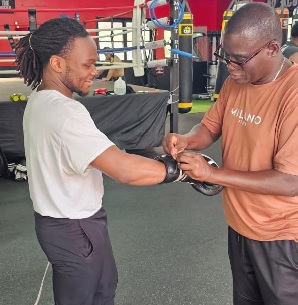
“We’re producing records, not champions,” Odamtten told the Graphic Sports during a working visit to his Camp Get Right Boxing Gym in Worcester, Massachusetts, last Wednesday.
It is a blunt assessment from a trainer whose credentials command authority and respect. Odamtten trained Ike ‘Bazooka’ Quartey to win the WBA welterweight title in 1994 guiding one of Ghana’s finest world champions into unforgettable battles against some of boxing most formidable names, including Oscar De La Hoya, Crisanto Espana, Jose Luis Lopez and Oba Carr.
He has spent the past 17 years in the United States developing another generation of fighters.
His central argument may be uncomfortable but difficult to dismiss, maintaining that Ghanaian boxing still possesses considerable raw talent, yet too many prospects are being manufactured for appearances rather than being prepared for the unforgiving demands of world-class competition.
Compromised records
His most provocative accusation concerns the infamous practise of “Achi-Agbeshi”, the Ga expression used in Ghanaian boxing circles to describe arrangements in which opponents are allegedly paid by promoters to lose deliberately, allowing selected fighters to build impressive but misleading professional records.
“People began paying fighters to lose deliberately,” Odamtten said bluntly about a well-known practise. “A boxer is paid to go down so that another fighter’s record can be improved.”
He explained that the result is a dangerous illusion and the record is fiction, as a boxer may boast a perfect 20-0 record and appear ready for a major international contest, but the numbers conceal a lack of meaningful competition.
“It creates a false picture of a fighter’s ability,” the coach remarked. “They may look world-class on paper, but they have never been properly challenged.”
The consequences of this ‘cooked’ record become brutally clear once a Ghanaian boxer arrives overseas carrying a pristine 20-0 record, yet lack the technical adaptability, ring intelligence and competitive resilience required against credible opposition.
Odamtten sees the practise as the predictable outcome of a corrupted development process, whereby promising boxers are rushed into major assignments and lose heavily, thereby losing their marketability, confidence and international appeal almost overnight.
Careers that should have been carefully developed are effectively extinguished before reaching maturity.
The coach contrasts that approach with the patient preparation and international exposure enjoyed by a generation of world-class boxers Ghana produced in the past.
He cited the transformative 1991 trip to the United States involving Quartey and his former stablemate Alfred Kotey who trained alongside world champions, sparred with elite fighters and absorbed the demands of international boxing before being asked to survive at that level.
That environment exposed the fighters to elite standards, advanced methods and the intensity of top-level boxing.
Both later became world champions within a space of eight weeks in 1994, and fought some of the sport’s biggest names. Their development, the coach noted, was not protected from difficulty; it was strengthened by it.
Inadequate preparation
Modern Ghanaian prospects rarely receive the same opportunity. Instead, some are moved too quickly from limited domestic competition into major international fights, carrying consequences they have not been prepared to manage.
“You don’t throw fighters into major fights before they’re ready,” he said. “You prepare them patiently until the time is right.”
Coaching development represents another critical weakness.
Odamtten praised Ghanaian trainers for producing technically promising fighters despite working in poorly resourced gyms within an ecosystem desperately requiring investment and modernisation.
“I see many promising youngsters in Ghana,” he said. “Their coaches deserve enormous credit because they’re doing excellent work.”
The problem is what happens after the foundations have been laid.
“Many coaches reach a certain stage with their fighters but don’t have the opportunity to continue developing their own knowledge,” he said. “When learning stops, development stops.”
Boxing has evolved, particularly in defensive technique, conditioning, sports science and tactical preparation. Odamtten believes Ghanaian trainers need regular opportunities to travel, study successful systems and work alongside leading coaches before returning home with new ideas.
The consequences of failing to modernise are already visible. Ghana no longer consistently produces world champions like Azumah Nelson, Qyartey, Joshua Clottey, Joseph Agbeko, Isaac Dogboe or Richard Commey, or contenders highly ranked by the major sanctioning bodies — the WBC, WBA, IBF and WBO — as it did more than a decade ago. The decline has affected both the amateur and professional ranks.
Development pathways
For Odamtten, recovery must begin with an organised national pathway that takes young boxers through clearly defined stages of technical and competitive development.
“Everything begins with structure,” he said. “Every age group should know its objectives, and every coach should understand the long-term plan.”
Odamtten is careful not to blame local coaches for a system that gives many of them too little. He praises their ability to produce technically promising fighters in inadequately resourced gyms and an ecosystem in urgent need of investment and modernisation.
“I see many promising youngsters in Ghana,” he says. “Their coaches deserve enormous credit because they’re doing excellent work. But foundational coaching can take a fighter only so far.
For him, the sport continues to evolve through advances in defence, conditioning, sports science, recovery and tactical preparation.
Coaches who are denied further education eventually reach the limits of their knowledge, and their fighters reach those limits with them.
“Many coaches reach a certain stage with their fighters but don’t have the opportunity to continue developing their own knowledge. When learning stops, development stops.”
He wants Ghanaian trainers to travel, observe successful systems, work alongside elite coaches and return with fresh methods.
The striking part of Odamtten’s assessment is that he remains optimistic about the fighters themselves, saying Ghana still has talented young boxers with tremendous potential who need a structured development pathway to convert ability into ring credibility.
