
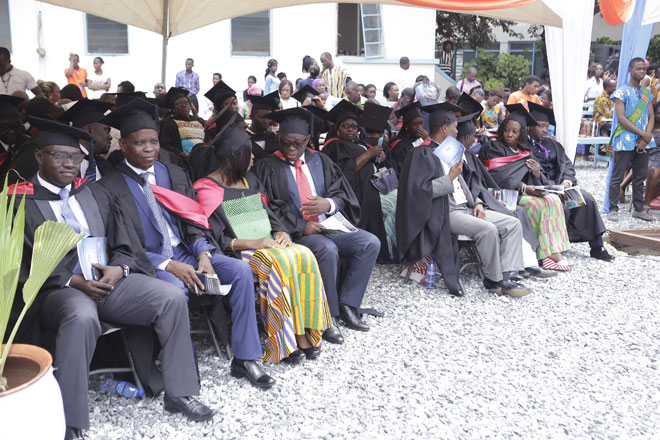
Every year, thousands of Ghanaian students graduate from universities with dreams of building successful careers and contributing to national development.
Graduation ceremonies are moments of pride for families and institutions, but beyond the celebrations lies a critical question: Are Ghana's universities producing graduates equipped for the realities of today's workplace?
The world of work has changed dramatically. Rapid advances in artificial intelligence, automation, digital technologies and global competition are transforming how businesses operate and the skills they require.
The challenge is becoming increasingly evident.
According to the Ghana Statistical Service (GSS), the national unemployment rate stands at 13.4 per cent, while youth unemployment is 19.7 per cent among people aged 15–35 years.
Although there is no official graduate unemployment rate, many university graduates struggle to secure jobs that match their qualifications.
Employers continue to question whether graduates possess the practical skills, adaptability and professional mindset needed in today's economy. Having worked in higher education for more than five years, engaging regularly with university leaders, employers, students and policymakers, I have seen both encouraging progress and persistent gaps.
Ghana has no shortage of talented young people.
The challenge is ensuring that university education translates into workplace competence and economic value.
Today's employers expect far more than academic excellence.
The World Economic Forum identifies analytical thinking, adaptability, technological literacy, resilience and continuous learning among the most important skills for the future.
Universities must therefore move beyond teaching theory to developing graduates who can solve problems, communicate effectively, collaborate across disciplines and embrace innovation.
Many employers acknowledge that graduates often require extensive workplace training before becoming fully productive.
Increasingly, organisations value individuals who can apply knowledge, think critically and respond creatively to new challenges.
This changing landscape demands a new approach to higher education.
Shift, gaps, lessons
One education leader who has consistently championed this shift is Prof. Fred McBagonluri, President of Academic City University. He believes universities should produce innovators and problem-solvers rather than simply awarding degrees.
Speaking at the University's recent graduation ceremony, he urged graduates to embrace lifelong learning, adapt to technology and continuously improve their skills, reminding them that success belongs to those who keep evolving beyond graduation.
Encouragingly, many universities across Ghana are responding. Academic programmes are being redesigned to reflect industry needs, while engineering capstone projects, entrepreneurship education, innovation hubs and career centres are providing students with greater practical exposure.
At Academic City University, students learn through interdisciplinary, project-based education where engineering, technology, business and communication students collaborate to solve real-world challenges.
Strong industry partnerships, internships and practical projects ensure graduates leave university with both technical competence and workplace experience. Despite this progress, many students still complete their studies with limited industry exposure and insufficient opportunities to apply classroom knowledge in practical settings.
One lesson from years of engagement with employers is clear: businesses do not expect universities to produce finished professionals.
They expect graduates with strong foundations, curiosity, adaptability and the confidence to contribute from their first day at work.
Achieving this requires stronger collaboration between academia and industry.
Employers should not only recruit graduates but also help shape curricula, provide internships, supervise student projects and mentor students throughout their academic journey. Soft skills also deserve greater attention.
While many graduates possess technical knowledge, employers frequently identify gaps in communication, teamwork, leadership and professionalism.
Universities must intentionally develop these competencies through presentations, collaborative projects, community engagement and experiential learning.
Entrepreneurship is equally important.
Ghana's economy cannot absorb every graduate into formal employment, making it essential for universities to prepare students to become job creators as well as job seekers.
Entrepreneurship education should go beyond writing business plans to helping students identify problems, develop solutions, build prototypes and test innovative ideas.
At Academic City University, entrepreneurship is integrated into every academic programme for two years, equipping students with the mindset and skills to innovate, create value and build sustainable businesses.
Shared
Building Ghana's future workforce is a shared responsibility. Government must continue investing in research, innovation and quality assurance, while regulators should encourage curriculum reforms aligned with labour market needs.
Industry must deepen its partnerships with universities through research collaboration, mentoring, guest lectures and support for innovation.
Students also have a role to play.
A university degree should mark the beginning, not the end, of learning.
Continuous self-development, professional growth and adaptability are essential for long-term success.
The question is not whether Ghana's universities are producing graduates.
They certainly are.
The real question is whether they are producing graduates equipped to compete, innovate and lead in a knowledge-driven economy.
If Ghana strengthens collaboration between universities, industry, government and students, higher education will do more than award degrees.
It will produce innovators, entrepreneurs and leaders capable of driving economic transformation and positioning Ghana as a competitive player in Africa's knowledge economy.
The writer is a public relations manager,
Academic City University.
