
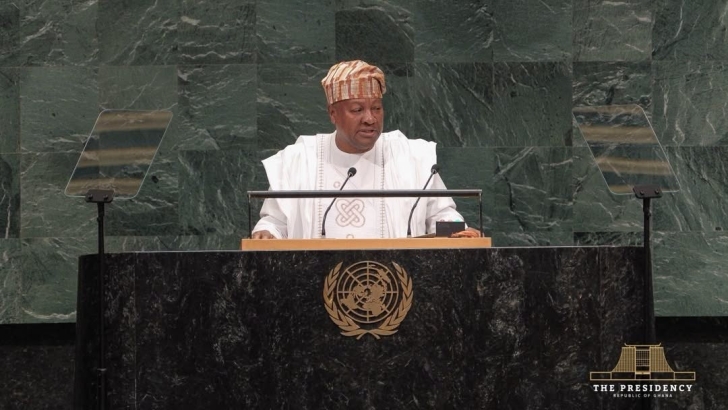
President John Dramani Mahama has justified the government’s decision to reject a new health compact presented by the United States to replace funding previously provided under the United States Agency for International Development (USAID).
The President described the conditions in the compact as humiliating and an affront to the country’s sovereignty.
Speaking at the Council on Foreign Relations in an event dubbed “A Conversation with President John Dramani Mahama” in New York on Friday (September 25, 2026) on the US health compact, President Mahama said Ghana, as a sovereign and democratic nation, subjected the document to due process.
He said the Ministry of Health studied the compact and presented a Cabinet Information Paper to Cabinet where several provisions in the document were flagged.
"It states that we shall give the United States our pathogen profile. It also says we should give our medical records. I mean, who takes another country's medical records?" the President said.
He added that the compact also required Ghana to commit a set amount of money as counterpart funding and stipulated that any medications or medical products brought into the country under the programme would not be subject to inspection by the Food and Drugs Authority (FDA).
"It was humiliating," President Mahama said.
The President said Cabinet rejected the compact in record time.
"It was the compact that was thrown out in record time in our Cabinet. I've never seen anything thrown out as fast as that. And so, of course, we rejected it," he stated.
He said the Minister of Health was subsequently directed to inform the US Ambassador that Ghana would manage on its own.
"We said no, we don't want it. And we're doing fine," President Mahama added.
Accra Reset
On the genesis and objectives of the Accra Reset initiative, President Mahama said the initiative was triggered by the abrupt withdrawal of US aid support.
He said, an amount of $174 million which had been programmed into the national budget was withdrawn, creating a significant gap in the education and health sectors.
He said the health sector alone suffered a $74 million shortfall annually, affecting critical areas including medical research, HIV and AIDS testing laboratories and the administration of the President's Emergency Plan for AIDS Relief (PEPFAR) programme, including the provision of antiretroviral drugs.
President Mahama said the development compelled government to make emergency budgetary provisions to cover the gap and reignited the conversation on Africa's health sovereignty.
"That set the whole ball rolling and led to the whole issue of the Accra Reset," he said, adding that the objective was to break dependencies and achieve health sovereignty by producing more medicines and vaccines on the continent.
The President recalled the lessons of the COVID-19 pandemic when Africa was last in the queue to receive vaccines because major vaccine producers were in the West. He said the continent must build capacity to produce its own medicines and vaccines ahead of future pandemics.
The Accra Reset, he said, aims to improve health outcomes and ensure that health remains a central pillar of Africa's development.
