
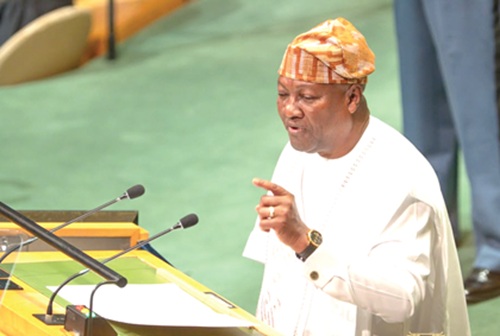
President John Dramani Mahama has demanded from world leaders equal partnership anchored on mutual respect for Africa, stressing that the continent is not asking for charity.
The President, who was addressing the United Nations General Assembly (UNGA) in New York yesterday, also warned that the continent would no longer accept the colonial model of resource extraction.
Addressing the packed room of diplomats and heads of state and government who listened attentively and regularly clapped at salient demands, President Mahama said Africa's demographic and resource endowment placed it at the centre of the world's future, but that future must be defined by Africans themselves.
"Our continent possesses the world's youngest population, vast arable lands, and parallel cultural vitality and the critical minerals required to drive the global green energy transition," he stressed.
Issuing a strong warning to major powers competing for Africa's green transition minerals, including lithium, cobalt, manganese, graphite and rare earths, President Mahama said the continent would not remain a spectator in its own transformation.
"Let me warn. Africa will not remain a passive arena for a new scramble for resources.
"Critical mineral extraction in Africa must not replicate the colonial-era exploitation.
We will process our minerals at home.
We will build local industries that create dignified jobs for our youth, and we will retain the value of our natural resources in Africa,” he said.
Dismantle engines of exploitation
President Mahama called on the UN to move beyond symbolism and dismantle what he described as the "persistent engines of exploitation" that continued to hold Africa and the Global South in subjugation, including unfair trade, predatory resource extraction and a punitive global financial architecture.
On the adoption of the landmark Resolution on Reparatory Justice, President Mahama said it must now lead to structural transformation of global governance and finance.
"Real repair demands structural transformation. It requires dismantling the persistent engines of exploitation, unfair global trade, predatory resource extraction, discriminatory credit ratings, unsustainable debt burdens of the Global South, and the continued export of raw materials from Africa, while real value addition and job creation occur elsewhere," President Mahama said.
The President argued that the resolution was necessary because the structural legacies of slavery continue to fuel modern inequalities.
"It was adopted because the structural legacies of those historic crimes continue to fuel systematic racism, economic marginalisation, and a global financial architecture that is weighted against Africa and people of African descent," he said.
He welcomed what he called “positive overtures” since the resolution's passage.
"We welcome the positive overtures from many countries and institutions that have joined the Dialogue on Reparative Justice.
The Netherlands, Germany, and France have all made positive moves to join the conversation on reparative justice."
President Mahama, however, warned that dialogue alone was not enough.
"Mr President, the injustices of the past remain embedded in today's power structures," he said.
Systemic inequalities
President Mahama added that the same systemic inequalities permeate the international financial system.
He indicated that developing nations and the Global South borrowed at interest rates that were up to eight times higher than industrialised nations.
The President added that African and Caribbean nations struck by climate disasters were forced to take on crippling debts to rebuild from floods and droughts that they did not cause.
"Governments are forced into a tragic choice to service predatory debts or to serve their people.
We demand reform.
We need long-term, affordable, and accessible concessionary financing that enables developing economies to invest in human capital, in industrialisation and climate adaptation," he said.
Africa must have permanent UNSC seat
Making the case for urgent UN Security Council reform, President Mahama said Africa's exclusion was indefensible.
"Africa is home to 1.5 billion people, over 18 per cent of humanity, and constitutes the largest regional voting bloc in this General Assembly.
And yet, Africa remains without a single permanent seat on the United Nations Security Council.
This is fundamentally unacceptable in the 21st century.
"Africa must be granted permanent representation on the UN Security Council, complete with all the rights and responsibilities.
We cannot credibly champion the sovereign equality of nations while preserving a global governance structure that was designed for the post-war geopolitical realities,” he said.
The President added that the Security Council reform was not a favour to Africa, but an imperative for the legitimacy, the credibility, and the survival of the UN.
Condemnation of embargo
President Mahama warned of an alarming breakdown of the current global order, saying the world is witnessing a dangerous shift towards unilateralism, lawlessness and the erosion of multilateral norms, and that the United Nations must not suffer the fate of the League of Nations.
He said the UN Charter must reign supreme over the cynical doctrine that might made right, stressing that the credibility of the global system was being tested by selective application of international law.
President Mahama condemned the actions of Israel in Gaza, stressing that nowhere was the crisis of credibility more painful than in the ongoing persecution of the Palestinian people in Gaza and the West Bank.
He also condemned the actions of Hamas, which have led to the actions of Israel.
The President called on world leaders to stop hiding behind diplomatic language, saying, "The time has come for us to stop using diplomatic euphemisms to veil the human carnage that is taking place in Gaza.”
"Collective punishments, enforced starvation, and mass displacement are flagrant violations of international law,” he said.
President Mahama reaffirmed Ghana's long-standing foreign policy position on the Middle East.
"Ghana remains unwavering in its recognition of the sovereign state of Palestine and its steadfast support for a viable two-state solution where Israel and Palestine will live side by side in peace and security, with guaranteed borders.”
“At the same time, we condemn all acts of terrorism by Hamas that triggered this conflict.
And we insist that all parties unconditionally respect international humanitarian law. Our moral standards cannot be selective," President Mahama stated.
Lift embargo on Cuba
President Mahama also reiterated the country’s call for the immediate lifting of the decades-long economic, commercial and financial embargo imposed on Cuba by the United States.
The President also drew attention to what he described as the world's worst humanitarian crisis in Sudan and the worsening security situation in the Sahel.
President Mahama added that the Middle East crisis was having a deleterious effect on the world economy and called for a return to the negotiating table.
"We call for a return to the negotiating table. And let me add that no human civilisation deserves to be annihilated and certainly not a member of the United Nations," President Mahama stressed, insisting that international law must be applied uniformly, regardless of where conflicts occur.
Ghana's democratic credentials
President Mahama touted Ghana's democratic credentials as arguably the most stable on the continent and called on African leaders to embrace the same.
"I agree that even as we demand a place at the table and call for a more equitable and just global order, as African leaders, we must also do what is required to put our own houses in order.
"As the legal maxim goes, whoever comes into equity must come with clean hands.
African leadership must be transparent and accountable.
We must commit to the fight against corruption and ensure that every dollar of our people's money counts and is used efficiently in their interest,” he said.
Ghana’s experience, economic turnaround
President Mahama said Ghana's experience proved that democracy could deliver when it was anchored on the rule of law and respect for human rights.
"Ghana is arguably the most stable democracy in Africa.
We believe in the rule of law and have respect for human rights.
And we are determined to demonstrate that democracy works.
While progress in a democracy may be slow because it must follow constitutional processes, it is more sustainable because it is built through popular participation and consensus building," he said.
"Ghana remains an uncompromising beacon of constitutional democracy, media freedom, the rule of law, and peaceful transitions of power on the African continent," the President added.
He said these domestic achievements set the stage for two historic milestones ahead.
"In March 2027, Ghana will celebrate its 70th anniversary of independence as the first nation in sub-Saharan Africa to break the shackles of colonial domination," he said.
Ghana would also assume the chairmanship of the African Union the same year to drive the agenda of industrialisation, regional integration and AfCFTA implementation, he added.
The President said his administration's transformative Resetting Ghana agenda was leading by example at home.
"Less than two years into my administration, through disciplined governance and fiscal prudence and an uncompromising fight against corruption, Ghana has achieved a dramatic economic turnaround.
“Indeed, some circles describe it as a Ghanaian miracle," President Mahama told the UNGA.
The President said macroeconomic stabilisation measures had restored growth, drastically reduced inflation, stabilised the cedi and significantly lowered the public debt burden.
"This remarkable economic recovery story has been independently validated by all the multilateral financial institutions and major international credit rating agencies, all of which affirm that Ghana has moved from economic vulnerability to sustained recovery, resilience, and growth," he said.
He stressed that because those macroeconomic achievements alone were not enough, the government had outlined an aggressive national infrastructure agenda under the Big Push programme to build roads, expand digital connectivity, and construct schools and health facilities.
He also cited the flagship 24-Hour Economy and Accelerated Export Development programme and the soon-to-be-launched “New Ghana Economy Policy” as vehicles to transform Ghana into an industrial, high-productivity hub.
He said the government was incentivising round-the-clock commercial operations, driving value addition in agriculture, mining, and creating sustainable, dignified jobs for our vibrant youth and women.
He also touched on the revolutionary expansion of social protection, universal health care and delivery on the Sustainable Development Goals, specifically SDG 1 on no poverty, SDG 3 on good health and well-being, and SDG 10 on reducing inequality.
"Ghana has officially launched a historic free primary healthcare programme, ensuring that every Ghanaian can access essential primary healthcare services at their community level at zero cost,” he said.
This programme, he said, had been hailed by the World Health Organisation and the UN as a benchmark paradigm shift for the Global South, he said.
