


MORE than 770,000 businesses in the country operate not from offices or shops, but from pavements, roadside stalls and the sheer momentum of hawkers pushing carts or balancing wares on their heads.
This is part of the findings from the first Integrated Business Establishment Survey (IBES I) carried out by the Ghana Statistical Service (GSS), which concentrated on previously unmeasured areas.
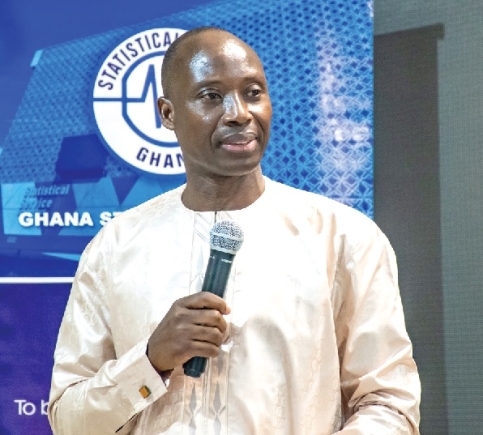
The Government Statistician, Dr Alhassan Iddrisu, who presented the findings at a press briefing in Accra on March 19, said the survey findings revealed a national business landscape of 2,644,358 enterprises, a figure that rewrites the understanding of Ghana’s commercial terrain.
Of the number, 1.87 million operate from fixed structures, representing the formal and semi-formal backbone of the economy.
He further disclosed that the remaining 30 per cent, which is 693,748, operate under an open-space business.
These are businesses that operate in fixed locations but not within structures, leaving them directly exposed to weather conditions.
The survey identified 82,920 mobile business operators nationwide. Women account for 64,237 operators, representing 77.5 per cent, while 52,000 operators, representing over 60 per cent, are aged between 15 and 35.
"That is those operating at fixed locations but without permanent structures, such as sheds and roadside stalls – and 82,920 mobile businesses, ranging from hawkers navigating traffic to traders using carts, bicycles and motorcycles," he stated.
Dr Iddrisu said when combined, the 776,668 enterprises were not marginal, but central to how millions of Ghanaians earn a living and access goods.
The survey, Dr Iddrisu said, had systematically captured the vast universe of mobile and open-space enterprises that had long existed beyond the reach of official statistics.
“These businesses were visible in daily life, but largely invisible in official statistics,” the government statistician told journalists at the Census Secretariat in Accra.
Dr Iddrisu stressed that the evidence should serve as a foundation for targeted policy.
He called for investments in market infrastructure, including sheds, storage and sanitation, particularly in the high-density trading zones where open-space businesses cluster.
Dr Iddrisu further urged financial institutions to expand microfinance, mobile banking and digital payment solutions tailored to informal traders, alongside training in business management, financial literacy and digital skills.
For metropolitan, municipal, and district assemblies, he recommended integrating mobile traders into urban planning rather than treating them as an afterthought.
“These businesses are everywhere around us – the traders selling food and household goods along streets and neighbourhoods, the vendors moving through traffic and communities selling goods directly to consumers,” the government statistician said.
Open-space businesses employment
Open-space businesses alone employ 922,177 people, making them a formidable source of employment.
Women dominate this space, accounting for 79.5 per cent of workers and 84 per cent of business owners, positioning open-air commerce as one of the most significant channels for female economic participation in the country.
Among mobile traders, women constitute 77.5 per cent of operators.
“These businesses are critical for livelihoods, especially for women and young people; they also play a very important role in bringing goods closer to households and to our communities," he said.
He asserted that the sector’s activity was heavily concentrated in urban hubs, with the Greater Accra Region accounting for 24 per cent of open-space enterprises and the Ashanti Region a further 17 per cent.
Food and beverage retail dominates, accounting for 68.4 per cent of all activity, underscoring the role traders play in household food security and daily commerce.
"Yet, despite their ubiquity and resilience – the average business has operated for about six years, with 63.7 per cent open at least six days a week – earnings are starkly uneven," the government statistician pointed out.
The survey showed that approximately 31 per cent of open-space businesses took home GH₵100 or less daily, while one in five earned GH₵500 or more, revealing deep income stratification within a sector often treated as homogenous.
For mobile businesses, the situation is even more precarious with 57.1 per cent of operators earning less than GH₵100 a day, reflecting the subsistence-level income that characterises much of the sector, Dr Iddrisu said.
Many work extended hours, with nearly half exceeding 49 hours weekly, yet returns remain modest, the survey said.
Child labour
Dr Iddrisu expressed concern about the child involvement dimension of the data, noting that the survey found 2,087 children aged between 10 and 14 engaged in mobile business activities, with girls accounting for 80 per cent of that group.
More than 80 per cent of the children worked for others rather than owning the goods they sold, pointing to vulnerabilities that extended beyond economic participation into labour exploitation.
He added that the phenomenon was most pronounced in the Upper East, Northern and Oti regions, where child labour intensity exceeded 10 per cent in 26 districts.
The government statistician stated that, although the figure accounts for a small part of the overall mobile trading population, it indicates ongoing child labour issues that enforcement of the Children's Act, 1998 (Act 560), and targeted social protection measures have yet to eliminate.
Non-Ghanaian operators
The survey also showed that non-Ghanaian operators, numbering nearly 5,000, are concentrated in border regions – Volta, Upper West, North East and Northern – with a distinct commercial profile.
Unlike their Ghanaian counterparts, more than half engaged in non-food retail, reflecting cross-border trade dynamics that have until now been poorly captured in national data.
According to the survey, ownership is overwhelmingly local, with 99.2 per cent of open-space businesses held by Ghanaians.
Digital integration on the rise
The report also highlights the potential of digital finance to reshape the sector.
More than 53,000 open-space businesses now operate as mobile money agents, suggesting that even within the informal economy, there is a growing appetite for digital integration that could, with the right support, improve credit access and record-keeping.