
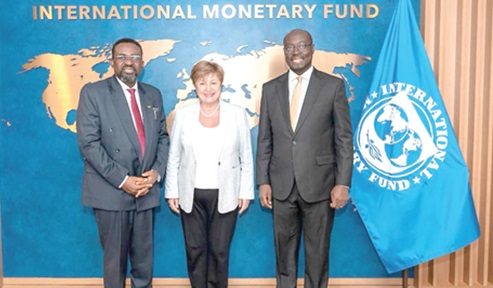
Ghana has successfully concluded its Extended Credit Facility (ECF) programme with the International Monetary Fund, achieving macroeconomic stability and debt sustainability ahead of schedule, the government has announced.
The development marks the formal end of the country’s financial bailout arrangement with the IMF, following what officials describe as a sharp economic turnaround after the programme veered off track in late 2024.
According to the government, the administration of President John Dramani Mahama, which assumed office in 2025, implemented frontloaded fiscal consolidation measures, expenditure rationalisation, and structural reforms to restore the programme to stability.
The Ministry of Finance says these interventions have produced tangible results, including a significant decline in inflation, a stronger cedi, reduced public debt as a share of GDP, and a broad recovery in economic growth.
Government spokesperson Felix Kwakye Ofosu in a statement said Ghana’s sovereign credit ratings had improved from restricted default status to “B” with a positive outlook, representing five successive upgrades.
He said the improvement reflected stronger fiscal discipline, normalised relations with creditors, improved external buffers, and renewed investor confidence.
Gross international reserves have also risen to a record level of about US$14.5 billion as of February 2026, offering nearly six months of import cover.
“This buffer provides Ghana with the capacity to withstand external shocks and stand on its own feet,” the government statement said.
Following the conclusion of the bailout programme, Ghana will now engage the IMF under the Policy Coordination Instrument (PCI), a non-financing arrangement that provides technical assistance and supports the implementation of economic reforms.
The government explained that the PCI framework does not provide funding but serves to strengthen policy credibility, attract private capital, and support access to financing from development partners.
Officials say the new arrangement is expected to complement efforts to secure an investment-grade credit rating, which would reduce borrowing costs, attract long-term institutional investors, boost foreign direct investment, and improve access to cheaper infrastructure financing.
The government expressed appreciation to citizens for their sacrifices and resilience, as well as to bilateral creditors, the Official Creditor Committee, and domestic and international investors for their support during the restructuring period.
President John Dramani Mahama and his administration, the statement added, remain committed to fiscal discipline, good governance, and creating an enabling environment for investment and job creation.
“This engagement will support government’s effort to accelerate sustainable development, create jobs and raise living standards for all Ghanaians,” Mr Kwakye Ofosu said.
