


Inflation slows to 3.2% in March: Oil price rise poses risk — Analyst
A management accountant and tax expert, Albert Kungmaa Ziem, has urged the government to scale up investment in agriculture and manufacturing as a practical step toward reducing import dependence and controlling inflation more effectively.
He explained that the country’s strong reliance on imports continued to put pressure on prices, especially when the cedi weakens or global costs rise, a trend that makes it harder to manage inflation sustainably.
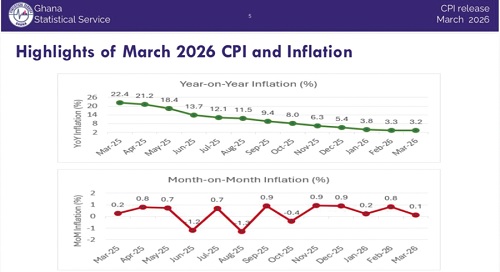
According to new data released by the Ghana Statistical Service (GSS), the inflation rate dropped from 3.3 per cent in February 2026 to 3.2 per cent in March this year.
The figure marks the 15th consecutive month of declining inflation and represents a sharp drop from 22.4 per cent recorded in March 2025.
Government Statistician, Dr Alhassan Iddrisu, said the latest figure was the lowest recorded since the rebasing of the Consumer Price Index in 2021, describing it as evidence of a steady return to price stability.
He stated that the moderation in inflation continued to be largely driven by easing food prices, although non-food items are still registering marginal increases.
In an exclusive interview with the Graphic Business, Mr Ziem, who is also a legal practitioner, said the decline in inflation implied improved purchasing power for households, as incomes could now buy more goods and services compared to the previous year.
He said although the trend looked positive, external developments, including rising crude oil prices, could reverse the gains.
“Higher fuel costs were likely to push up transport and production expenses, which would feed into inflation in the coming months,” he said.
He added that inflation could rise again in April if global price pressures persisted, observing that increases in energy and logistics costs would affect almost all sectors of the economy.
Addressing concerns about the gap between official inflation figures and the cost of living experienced by consumers, Mr Ziem said inflation slowing did not mean prices were falling.
He explained that prices were still rising, but at a slower rate, and that a reduction in prices would have meant deflation.
“People felt prices were high because goods had not become cheaper, even though the pace of increase had slowed,” he said.
He further noted that Ghana’s inflation had been largely influenced by external factors, as many goods were imported.
“Encouraging local production would help contain inflation more effectively,” he said.
Food and non-food trends
Food inflation declined further to 2.3 per cent in March from 2.4 per cent in February. On a month-on-month basis, food prices fell by 0.3 per cent, providing some relief to households.
Non-food inflation also eased slightly to 3.9 per cent in March from 4.0 per cent recorded in February. However, on a monthly basis, non-food prices increased by 0.3 per cent.
The contrasting movement between food and non-food categories pointed to different cost pressures across sectors.
While food prices eased due to improved supply, non-food items recorded slight increases.
The Government Statistician said the trend had shown a gradual shift in price pressures across the economy.
Dr Iddrisu said food prices had declined on a monthly basis while non-food costs had remained under pressure, which showed that the easing had not been uniform.
Goods and services divide
Inflation for goods slowed significantly to 1.7 per cent in March, down from 3.2 per cent in February.
On a monthly basis, goods prices fell by 1.0 per cent, contributing strongly to the overall decline.
Goods accounted for a large share of the CPI basket, making their slowdown a key driver of the disinflation trend.
The drop reflected easing supply constraints and improved market conditions.
In contrast, services inflation rose sharply to 7.2 per cent in March from 3.7 per cent in February.
Month-on-month, service prices increased by 0.4 per cent, indicating rising costs in areas such as transport and accommodation.