
What is unfolding at Atronie and its adjoining farming communities in the Sunyani Municipality of the Bono Region is more than a fight over land.
It is a battle to protect fertile farmlands, millions of cedis in agricultural investments and the livelihoods of thousands of people who depend largely on farming for survival.
As miners mobilise equipment and personnel in the area, residents fear that decades of agricultural investment in cocoa, cashew and food crop production that have sustained generations could be wiped out.
They also worry that the Amuma River, the only source of drinking water for about 22 communities, could be placed at risk if mining activities commence.
For the people of Atronie, the struggle is not simply about resisting what they described as illegal mining; it is about protecting a way of life that has sustained generations.
For generations, the fertile lands of Atronie and its adjoining communities have fed families, financed the education of children and provided employment for thousands of people.
Legacy under threat
However, that legacy is under threat. Many farmers fear that decades of hard work, investment and sacrifice could be wiped away within a few months.
Deep inside the forests surrounding the community, excavators and other heavy mining equipment have created paths through farmlands and vegetation, signalling the advance of illegal miners whose presence has sparked fear, anger and uncertainty among farmers and chiefs.
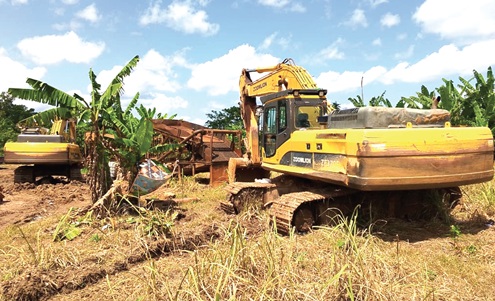
Heavy mining equipment mobilised to the Atronie area ahead of planned operations
The fear of losing a harvest now hangs heavily over the community.
At the peak of the planting season, some farmers say they could not even access their lands because of the presence of armed men guarding the mining equipment and the mining area.
Others worry that if the miners succeed in taking over the area, productive farms could give way to vast pits and degraded landscapes, leaving generations of agricultural investment buried beneath the quest for gold.
Determined to protect their lands, chiefs and community members have repeatedly visited the site to demand the departure of the operators.
At a recent press conference held by the Atronie Traditional Council, the Secretary of the Council, Nana Yaw Ampofo, issued a one-week ultimatum for the miners to vacate the area.
According to him, community leaders had already made an earlier attempt to persuade the miners to leave peacefully.
Instead of complying, Nana Ampofo said the miners increased their presence.
"What we saw during our second visit was alarming.
The number of excavators had increased from three to 10," he said.
The traditional council insists that the people were not seeking confrontation but were determined to defend their farms, rivers and investments.
"We do not want to be seen as lawless people.
We are simply protecting what belongs to us and preserving the future of our children," Nana Ampofo stated.
He appealed to President John Dramani Mahama to intervene to protect their farmlands, environment and investment.
Visit
When the Daily Graphic visited the area, excavators, changfangs and other mining equipment were stationed deep in the forest.
Armed private security personnel guarded the equipment and the vast fertile land, creating an atmosphere of intimidation.
The Daily Graphic investigations revealed that the presence of the armed men had restricted farmers' movement and prevented some of them from accessing their farms during this critical planting season.
A farmer, Kwabena Asante, told the Daily Graphic that "this is the time we should be preparing our lands and planting crops."
He said instead, many of them were staying at home because they were afraid, adding that some people had crops ready for harvesting, but they were scared to go near their farms.
Mr Asante said farming was all they knew, "Our children go to school because of these farms. If the farms are destroyed, how do we survive?"
His concerns echo throughout the community.
Abandoned
Many residents say they feel abandoned as the miners continue to expand their activities despite warnings from traditional authorities.
Beyond the farms, residents are deeply concerned about the Amuma River, the main source of drinking water for about 22 communities in the area.
The river has sustained generations of farmers, families and livestock.
Environmental experts have repeatedly warned that illegal mining, popularly known as "galamsey" activities, often contaminates water bodies with silt, chemicals and other pollutants, rendering them unsafe for human consumption.
If the Amuma River becomes polluted, residents fear they may be forced to travel long distances in search of potable water.
In many parts of the country, illegal mining in particular has left rivers polluted, forests destroyed, and farmlands permanently damaged.
Residents say they do not want Atronie to become another example of a community sacrificed in the pursuit of quick wealth.
Agricultural investment
For residents, the greatest fear is what happens next if the miners are allowed to proceed with their activities.
While mining operations are yet to begin, the growing presence of excavators and armed guards has heightened concerns that millions of cedis invested in cocoa, cashew and food crop production could be wiped out if the miners are allowed to proceed.
The hundreds of acres of cocoa and cashew plantations under threat of destruction represent years of labour and financial commitments by farmers and investors.
Unlike annual crops, tree crops take years to mature.
A cocoa farm, for instance, may require three to five years before yielding commercial harvests.
Cashew plantations demand similar patience and investment.
The destruction of such farms would mean wiping out years of hard work overnight.
For many households, such losses would be impossible to recover from.
Food security concerns
Another farmer, Frank Adu-Appiah, expressed fear of food insecurity and malnutrition if the galamseyers succeeded in mining.
He said reduced access to their farms could lead to lower production and declining incomes for them.
"Consumers in nearby towns and cities could eventually face shortages and rising food prices," Mr Adu-Appiah said.
When contacted, an official at the Bonoregional office of the Environmental Protection Agency (EPA) said he could not immediatley comment in the situation.
Conclusion
For the people of Atronie, the issue goes beyond mining. It is about protecting rivers and fertile lands that feed families, educate children and sustain local economies.
For now, farmers wait anxiously, hoping their fields will not become the next battleground in Ghana's fight against illegal mining.
Writer's email:
