


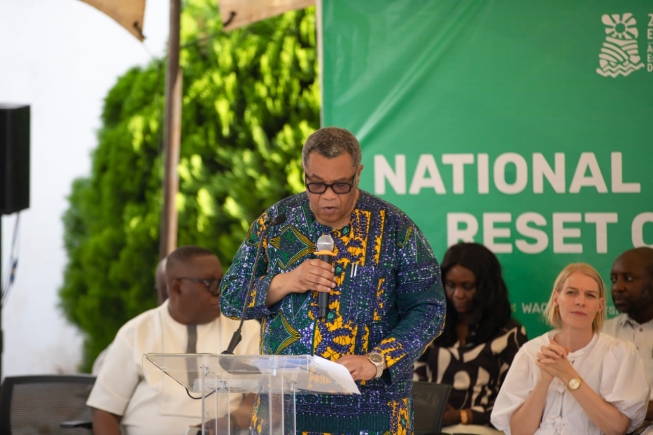
The government has officially declared war on the fragmented and underperforming seed sector that has for decades constrained agricultural productivity, launching a comprehensive national reset aimed at treating seed as critical economic infrastructure.
At a high-level convening underway at the West Africa Centre for Crop Improvement (WACCI) at the University of Ghana, the 24-Hour Economy Authority, in partnership with the Ministry of Food and Agriculture, international development partners, and key industry stakeholders, is overseeing what officials describe as a transition from decades of policy dialogue to binding decisions and time-bound execution.
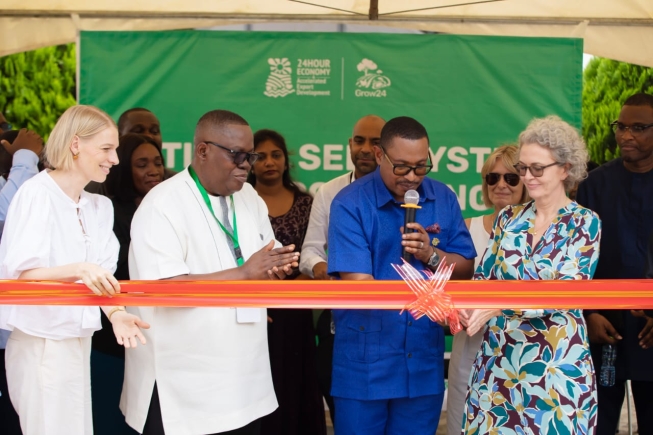
Delivering the keynote address on the first day of the two-day National Seed System Reset Convening on March 16, 2026, the Presidential Advisor on the 24-Hour Economy, Goosie Tanoh, set an unambiguous tone. He told the gathering of approximately 120 decision-makers that the era of diagnosing problems must give way to building solutions.
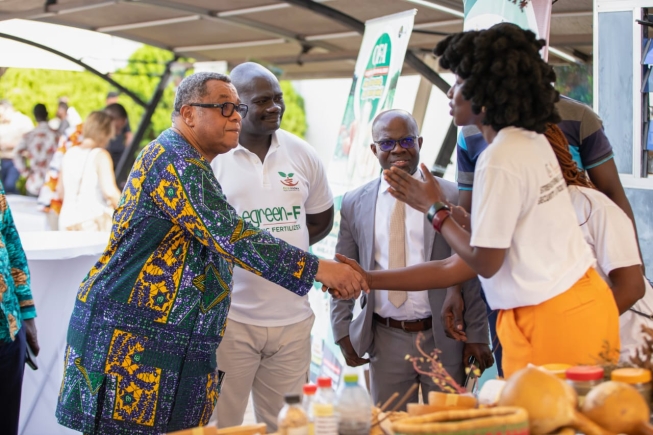
"What we experienced this afternoon is not a side event; it is the front door to how Ghana will deliver the 24H+ vision on the ground," Mr. Tanoh said, referring to a tour of WACCI's laboratories, early-generation seed facilities, and a joint exhibition featuring the Council for Scientific and Industrial Research (CSIR), the National Seed Trade Association of Ghana (NASTAG), and international partners including the Ghana-Netherlands Seed Partnership.
The exhibition and tour were designed to demonstrate that Ghana already possesses significant scientific and institutional capacity. The challenge, according to the Presidential Advisor, is not the absence of capability but the lack of coordination, architecture, and execution.
"As we move deeper into 2026, 24H+ is an execution programme, not a design exercise. This year, we want to be assessed by jobs created, SMEs financed, parks and corridors that are actually producing, capital that is legally committed and deployed, and systems that outlive political cycles," he stated.
The targets for 2026 are ambitious: 200,000 jobs activated, 500 SMEs onboarded into structured finance and park ecosystems, over GHS 10 billion in capital commitments, a functional Volta Economic Corridor with at least five agroecological or aquaculture parks, three industrial parks operational, and three cooperative-owned production and processing enterprises fully running.
Mr. Tanoh was emphatic that none of these targets are achievable if the seed system remains broken. He noted that the seed spine developed during the convening will feed directly into GROW24 agroecological parks, Feed Ghana centres, cooperative models, and the price stabilisation systems that support market predictability.
"When we discuss activating parks, corridors, export platforms, and cooperative enterprises, we are essentially talking about reliable access to quality seed, combined with anchor demand, finance, and logistics," he explained. "If we get the seed architecture right, then every 2026 deliverable in this strategy becomes easier to achieve."
The convening's framing document, prepared by the 24H+ Authority with technical support from WACCI, CSIR, the UK Foreign, Commonwealth and Development Office (FCDO), and the Netherlands Enterprise Agency, lays bare the scale of the challenge. Despite decades of policy reform and the privatisation of seed production, fewer than ten per cent of Ghanaian farmers use certified seed. Productivity gaps persist across major food crops, undermining the objectives of the 24-Hour Economy and the Feed Ghana Programme.
The document draws on international evidence from nine countries, including the Netherlands' "Diamond Approach" of structured collaboration among government, private sector, research institutions, and civil society; Ethiopia's cooperative-based seed multiplication systems; Rwanda's rapid regulatory reform; and India's government de-risking model. These international lessons are being applied to Ghana's specific circumstances.
A key message emerging from the sessions is the need for a clear division of labour. The government's role is to de-risk through policy clarity, regulatory predictability, and demand guarantees via programmes like Feed Ghana and GROW24. The private sector is expected to deliver production, distribution, and quality assurance at scale. Research institutions must secure the variety pipeline and supply early-generation seed reliably.
Mr. Tanoh also addressed the critical issue of intellectual property, stressing that innovation must be protected. "Ghana's breeders, research institutions and private seed companies will only sustain high-quality pipelines if we protect plant breeders' rights, respect licensing agreements, and ensure that public-private partnerships around varieties are transparent and enforceable," he said.
The first day of the convening featured a campus tour and an exhibition showcasing the capabilities of NASTAG members, CSIR research institutes, the Ghana Atomic Energy Commission, Legacy Crop Improvement Centre (LCIC), Integrated Water & Agricultural Development (Ghana) Limited (IWAD), the Beela Project with TRAX, and the Ghana-Netherlands Seed Partnership. The objective was to demonstrate that Ghana possesses the institutional foundation that now needs to be organised into a coherent national seed delivery system.
Today's main convening will move from observation to decision. The agenda includes diagnostic sessions on why the current system is failing, followed by the development of architectural principles for a new seed delivery system. Participants will break into crop-specific groups for maize, rice, tomato, cassava, and oil palm to develop tailored delivery models that link breeding, early-generation seed production, commercial multiplication, and markets.
The ultimate outcome, expected by the close of the event, is the establishment of a multi-stakeholder Seed Systems Task Team with a 60-day mandate to present a detailed implementation roadmap. Within 90 days, the government expects to see early-generation seed plans firmed up, regulatory quick wins underway, and pilot delivery models for maize and rice aligned to the GROW24 and Feed Ghana programmes.
The event is co-hosted by the Netherlands Embassy and the UK-Ghana JET programme, a Foreign, Commonwealth and Development Office flagship initiative. FCDO has contributed £20,000, and the Netherlands Enterprise Agency has provided USD 20,000 in support. Technical facilitation is being led by experts including Dr. Amos Rutherford Azinu, Prof. Eric Yirenkyi Danquah, and leaders from CSIR and NASTAG.
As Mr. Tanoh told the gathering, "The work you do at the main convening is directly tied to whether we hit our 2026 targets for jobs, SMEs, capital deployment, and corridor activation."
The final implementation roadmap is expected to be circulated to all participants within one week of the event's conclusion.